Food Buzz Badge

Showing posts with label Italian. Show all posts

Thursday, August 23, 2012

Cucina Povera

I've been getting to work really early lately.  Part of it is being super-busy, which I love, but part of it is that I love being in the office when it is so quiet.  This morning I can hear the rain pounding on the roof.

We're on a downhill slide into fall here in Anchorage.  I've been meaning to take pictures of the transformation, which include a flock of Canadian geese gathering on the mud flats near my house and the blooming of the fireweed.  Alaska legend is you can tell how long it will be until winter by when the fireweed finishing blooming and then goes to cotton.

For the first time in a couple of weeks, I was home to make dinner last night.  On Golden Pond is fully blocked and going well, but the nights we aren't in rehearsal I'm usually staying late at work or running the errands that I haven't had time to do. 

Last night I was determined to make something delicious, simple and packable to take to work for lunch.  I am fascinated by the Italian concept of cucina povera--literally, poverty kitchen--not because of the financial aspect of it (we are fortunate in that regard), but because it means you make a delicious dish from basically nothing. 

This dish is so simple that I kept wanting to do something more with it, like adding anchovies, chicken sausage or olives.  In the end, I left it proudly unadorned, the way it was meant to be.  It originated in Puglia, the single food region I most want to visit in Italy and haven't had the opportunity to--yet.

Rigatoni with Bread Crumbs and Parmesan
Adapted from Lidia's Italy by Lidia Bastianich

1 eight-inch piece of white country bread--baguette, French, ciabatta
1/3 cup olive oil
4 large cloves of garlic, sliced thinly
1 lb. dried rigatoni
1/4 cup Italian parsley, chopped
1/4 cup good-quality Parmesan, finely shredded, with more for garnish if desired
4 small dried peperoncino peppers, crumbled
Good-quality finishing olive oil
Sea salt and freshly-ground pepper

Trim the crust from the bread and then pull it into crumbs with your hands.  The crumbs should be various sizes.

Start a large pot of water to boil for the pasta, adding at least a tablespoon of salt.

In a large skillet, heat the olive oil.  When it is shimmering, add the bread crumbs and garlic.  Toss the crumbs to coat them with the oil, and toss occasionally when cooking so that they brown and crisp.

When the water is ready, add the pasta and cook for about nine or ten minutes, until the pasta is al dente.  Reserve half a cup of the pasta water and drain the pasta thoroughly.  Then add it back to the pot and cover it until ready to use.

The crumbs will be ready when they are lightly golden and crispy--make sure not to scorch the garlic.

Toss the pasta with a little of the cooking water to coat it.  Add the crumbs, parsley, peperoncini and Parm to the pasta and toss thoroughly.  Season with salt and pepper, then drizzle with good-quality finishing olive oil and toss again.


Serve with another grating of Parmesan.  Makes six appetizer pasta servings or four generous main course servings.  I served this with a side of fried zucchini and a bottle of dry, minerally Gruner Veltliner.

Thursday, August 9, 2012

Dazed and Confused

Some weeks I feel like I'm sprinting for Friday, full of energy and purpose.  This week I feel like I'm crawling.

It hasn't been a bad week, just an exhausting one.  Work has been super-busy (not that I'm complaining--better that way than the reverse), and we just blitzed through blocking twenty-four pages of On Golden Pond over the last two nights.

Somehow, David and I have no plans for the next couple of nights.  I'm kind of grateful.  I foresee a long walk in my future tonight, followed by a glass of wine and some of the good cheese here my parents schlepped from one of the Italian markets in St. Louis.

A totally random photo demonstrating what happens if one flops on the
bed in our household.  Ingrid considers you her personal chaise.
David is doing somewhat better after his rib-fracturing bike accident a couple of weeks ago, but he's not up to hiking or other outdoor activity yet, so I also foresee a solo hike in my future this weekend.

We also received the latest CSA box, which includes a bunch of one of my favorite veggies, Swiss chard.  I love the stuff but am forever trying to find new ways to prepare it.

This recipe might win over people who don't particularly like dark leafy greens--it is savory and just slightly cheesy, and it has a terrific combination of tender and crispy bits.  While the original recipe did not call for oiling the pan prior before placing the chard cakes in it, they wanted to stick without it.  I thought it sounded weird not to oil the pan, but who am I to overrule Lidia?  Learn from my mistake.

Crispy Swiss Chard Cakes
Adapted from Lidia's Italy by Lidia Bastianich

1 lb. rainbow chard
2 tbsp. good olive oil
1/2 medium yellow onion, thinly sliced
3/4 tsp. sea salt
1 1/2 tbsp. unsalted butter
1/4 tsp. fresh-ground black pepper
1 cup Parmesan cheese, finely shredded
1 egg yolk, beaten

Wash the chard and trim off the stems, then trim away the central ribs.  You won't be using these for the dish, but they are great slow-cooked with a little broth, oil and garlic.

Bring a large pot of water to boil over high heat, then add the chard leaves.  Continue to let the pot boil for about twenty minutes, or until the chard is tender.  Drain and rinse the chard under cool water, and then finely chop the chard.

Here's the step I can't emphasize enough--squeeze every drop of water you can out of the chard, or the cakes will fall apart. 

Heat a large skillet over medium heat and add the butter.  When it is melted, add the onion and half a teaspoon of salt.  Cook the onion until it turns lightly brown, then add the chard and remaining salt.  Cook another 7-8 minutes, until the butter has all been absorbed.  You will want the chard to be dry but not crispy.

Remove the chard from the skillet and let the skillet cool.  When it is cool enough to handle, wipe it absolutely clean. 

When the chard is lukewarm to the touch, combine it with the cheese and egg yolk.  Divide the mixture into small patties and press them together firmly.  If there seems to be too much liquid in the mixture, squeeze some out and start again.

Reheat the skillet over medium heat and add the olive oil.  When the oil is shimmering, carefully place the chard cakes in the skillet.  Cook for about three minutes per side, then drain on a paper towel.


Serve warm--should make about four large cakes or six small ones.  We served them with a grilled Florentine steak, though they would make a fantastic addition to a vegetarian meal.

Thursday, June 28, 2012

Summertime Blues

I am so ready for the alternately gray, rainy and humid and brightly sunny weather in Anchorage to stop--it's as if the weather is bipolar.  Every morning I get up, poke my head out the window and decide whether to wear tights to work or if my legs will freeze if I go bare-legged.

Regardless of the weather, though, I am really in the mood for classic summer foods.  Ripe fruit, fresh corn and a good grilled steak all sound perfect right now.

Today I have the great good fortune to be guest blogging for the very first time for the lovely Kristen at Frugal Antics of a Harried Homemaker.  Her blog has been one of my favorites since I started blogging almost a year ago--she cooks creative, often gluten-free recipes that are economical and doable for the home cook.

In keeping with her philosophy, I give you this version of a summer succotash that can be adapted to whatever vegetables look good where you live.  It's vegetarian, healthy, simple to put together and full of flavor.  Serve alongside roasted meats or keep it vegetarian with a side of couscous or rice.  Either way, it's delicious--and I should know, since I've been eating the leftovers for lunch the last couple of days.  It's one of those dishes that gets even better the next day.

Check out this Farmstand Summer Salad with Jalapeno Butter here.

As a total aside, the terrific writer and director Nora Ephron, who directed Julie & Julia and You've Got Mail, and who wrote one of the all-time great screenplays, When Harry Met Sally, died Tuesday.  You may not know she started as a journalist and was once a food writer, which probably explains why there so many scenes of eating in her films.  The New York Times published a terrific article about her yesterday that talked about her love of food, which you can find here.

Now head on over to Kristen's blog and check out the salad!


Tuesday, June 12, 2012

Wherefore Art Thou, Dinner?

At the rate I'm going, it will be fall before I work through all of the posts related to my vacation.  Plus I promised the kick-ass salad recipe last week.  I seriously don't know where all the time goes.

David and I went to several regions in Italy, but the one we spent the least amount of time in was the Veneto.  This region, in northeastern Italy, is famous mostly for containing Venice, which we skipped this time around because we didn't have enough time to do it justice.  (As an aside, if you ever want to see a truly, atmospherically spooky movie, Netflix Don't Look Now, which stars Donald Sutherland and Julie Christie as a couple vacationing in Venice after losing their young daughter in an accident.  I seriously shrieked out loud at the end.)

Artwork made from recent letters written to Juliet.

The sole place we visited in the Veneto was Verona--the English major in me couldn't resist the opportunity to visit the place where two of Shakespeare's plays were set.  But sorry, Two Gentlemen of Verona, this city is all about Romeo and Juliet.  You can visit Juliet's balcony, Juliet's house and Juliet's tomb--and while the Capulet/Montague feud may have been based on history, you can bet that there was not really a Juliet.  Nevertheless, that doesn't stop throngs of tourists from visiting these attractions, particularly the balcony.

In the courtyard under the balcony, there is a statue of Juliet.  Legend has it that it is good luck to rub her right breast, and we saw lots of people doing it.  We skipped that little attraction and went into the house, which gives you an opportunity to go out on the tiny balcony.  Here's David standing on it, but sadly I couldn't get him to recite the balcony speech to the throngs below.

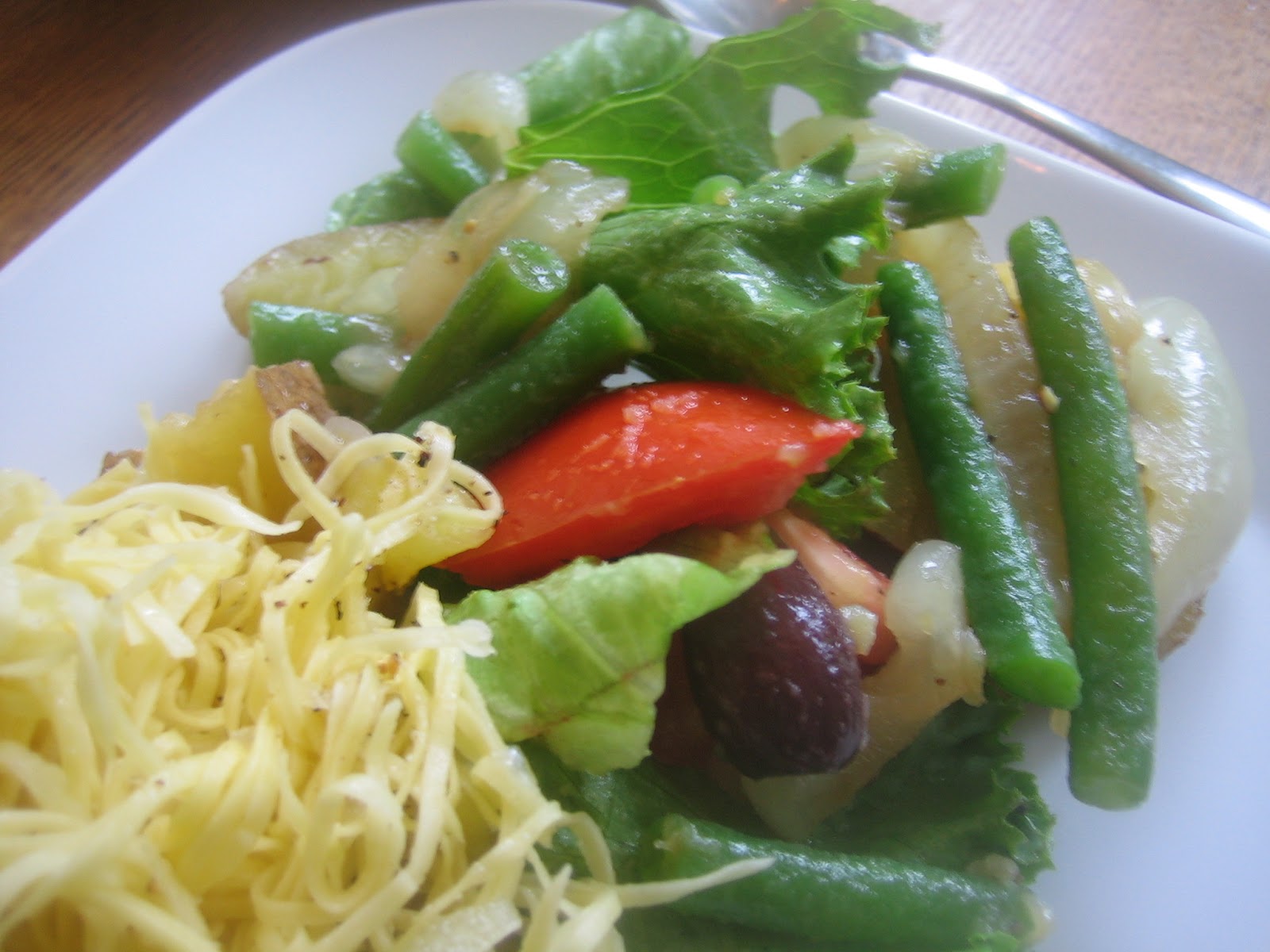
Verona is also home to some spectacular churches, and I had a terrific lunch there featuring a hefty pile of greens mixed with black olives, cannellini beans and chunks of terrific oil-cured tuna.  The kick-ass salad is definitely a relative of that Veronese salad, with the added advantage of being vegan.

This salad is all in the prep work, and could be varied according to the season.  We found one passable-looking tomato (Alaska gets notoriously terrible tomatoes), but the next time I would leave that out in favor of a vegetable in better shape.


Insalata Cruda e Cotta (Raw and Cooked Salad)

Adapted from Lidia's Italy
2 large, sweet yellow onions, peeled, trimmed and sliced 1/2" thick
1/3 cup extra-virgin olive oil
1/2 tsp. sea salt
1/2 lb. small red or gold potatoes
1/2 lb. fresh green beans, trimmed
1 fresh tomato, chopped
3/4 lb. fresh leafy salad greens
1/2 cup black olives, pitted
3 tbsp. red wine vinegar
Salt and fresh-ground black pepper to taste

Preheat the oven to 375 degrees.  Brush the onion slices with olive oil in both sides, and sprinkle with salt and pepper.  Lay them on the baking sheet and bake the onion slices approximately 25 minutes, flipping halfway through.  The onions should be a light golden brown when done.

While the onions are cooking, start a large pot of water to boil.  Clean the potatoes and drop them in the boiling water.  Cook just until the potatoes are cooked through--you want them to hold together and not get mushy.  Remove the potatoes--don't get rid of the boiling water!--and cut them in good-sized wedges when cool enough to slice.

Add the trimmed green beans to the water and boil just long enough to bring out the color, about four minutes.  You'll want the beans to stay crisp.  When you remove them from the water, put them in a bowl with cold water and ice cubes to shock them so you'll keep the gorgeous color. 

If you have a salad spinner, this is the time to put it to work.  Wash and thoroughly dry the greens--use your favorite in-season lettuces.  I had green leaf lettuce in my CSA box, so that's what I used, but it would be fun to use lettuces of different textures and colors.

In a ramekin or small bowl, combine the vinegar and remaining olive oil and whisk together.  Add salt and pepper to taste.  Then throw all of the ingredients except the lettuce and dressing in a large salad bowl and gently toss them together.  Add the lettuce and dressing and toss gently again;  serve immediately.

Makes four large salad servings.  If you do not plan to use all of the vegetable mixture, hold some back and don't toss it with the lettuce.  I had a couple lunches' worth of these salads later in the week.

Monday, June 4, 2012

To Rome, With Love

Yesterday, I actually got to see a movie.  In the theatre.  This happens less often than you would think.

One of the previews was for the new Woody Allen movie, To Rome with Love, which was apparently shot there last summer.  It stars Roberto Begnini, the Italian comedian who was the lead in Life is Beautiful, a movie I thoroughly disliked.  It's been more than ten years since it came out and I still can't believe it won an Oscar.  But I digress.  It doesn't necessarily look like a movie I like, but the shots of Rome were gorgeous.

David and I spent four days of our vacation in Rome, which is an unruly mixture of the ancient and modern.  You walk down a street of little restaurants and shops, and boom, there's the Colosseum.  You turn the corner from an equally modern street, and there are the Baths of Caracalla.  The latter of which closes promptly at 1 p.m. every single day, BTW, and woe to those who show up at 12:45. 

We had a couple of spectacular meals in Rome, which I will post about separately, but it's mostly not the major tourist sites that will stay with me, but things like the Borghese Gallery.  Unlike the Vatican museum, which was absolutely overrun with tour groups, the Borghese allows only a very tightly controlled number of people in at once and features spectacular art set in the gorgeous villa for which much of the art was purchased.  The villa is set in large, beautiful gardens and was one of the highlights of our time in Rome.  Tickets sell out several weeks in advance--if you're planning a trip to Rome, buy them once you know your dates.

There are certain sites in Rome that look exactly as you have seen them in movies and in photographs, the Colosseum foremost among them.  Then there are places that you've never seen, like the former Jewish Ghetto and the (still active) synagogue there.  If you have any interest in Jewish or Holocaust history, this is a must-stop place and is surrounded by a still active Jewish quarter full of small kosher restaurants.  The food was so good that David and I returned to one kosher meat restaurant for a second lunch.

That salad in the background is the bomb
It's coming at you later this week.

Since we arrived home six days ago, we've been eating a lot of Italian-style food.  For our anniversary a couple of months ago, David bought me another Lidia Bastianich cookbook, Lidia's Italy, in which she picks her favorite spots in Italy and provides recipes specific to that area.  This very simple pasta takes less than twenty minutes if you don't make your own pasta. 

At a restaurant in Emilia-Romagna, the homemade pasta had a gorgeous golden yellow color.  We asked the chef about the color, and he said that he simply doesn't use the egg whites.  David had to give it a try last night.  The color and texture were great, but it does yield a slightly stickier dough.

Pasta Cacio E Pepe
Adapted from Lidia's Italy

1 1/2 tbsp. whole peppercorns, coarsely ground
3/4 lb. fresh pasta or dried spaghetti
1 cup finely grated Pecorino Romano cheese
Extra-virgin olive oil (optional)

Boil a large pot of salted water for the pasta.  Depending on whether you are using fresh or dried pasta, cook either very briefly for the fresh or until just al dente for the dried.  Drain the pasta, but reserve a cup of the pasta water for tossing.

Put the drained pasta into a large bowl and toss with the cheese and pepper;  it will likely be very dry, so drizzle in the pasta water and a little olive oil until the cheese coats the pasta.  Adjust by adding more pepper, cheese or oil to taste.

Serve immediately.  Makes four small main course servings;  could serve six as a pasta course.

Thursday, May 31, 2012

From Rome to Munich

I'm back!  Although with a serious vacation hangover, otherwise known as jet lag, that causes me to wake up at midnight thinking I have had a full night's sleep and that it's time to get up because, after all, it's 10 a.m. in Europe.

It's the price I pay for having a fabulous vacation, right?  That and a couple of extra pounds despite walking an average of eight miles a day.  I'm back to the gym in a serious way.

David and I flew from Anchorage to Rome, which is less difficult than you might think--there is a flight that goes straight from Anchorage to Frankfurt in about nine hours, and then we caught a quick flight to Rome.  We stayed in Rome for four days and then gradually worked our way back through Florence, Bologna, Verona, Trento and Bolzano in northern Italy, Innsbruck, Austria and finally Munich before catching a train back to Frankfurt.

I am so happy to have a large supply of clean clothes and my own bed, and lots of material to share here.  To start, let me give you an aperitif.  Literally.

From Rome to Munich, I kept seeing wine glasses containing a slightly fizzy orange drink on every outdoor cafe table.  Either Aperol has a really great advertising budget, or, as I conceded when I finally tried one near the end of our trip, this was a brilliant drink.

Aperol is a liqueur made primarily of oranges, including blood orange, plus unidentified herbs and roots. 

An Aperol Spritz is a drink containing Aperol, sparkling wine and sparkling water.  It is traditionally consumed as an aperitif because it is light, relatively low in alcohol and a totally kick-ass color.  David and I brought a bottle of Aperol back to play with, and I'm hoping that I can find it here locally because it's going to become the drink of the summer.

Don't use your fancy champagne here.  Prosecco is the traditional wine of choice, but we made it with cheap Spanish sparkling wine (cava) and it tasted great.  Also, play with the proportions--David liked his with a little less sparkling wine and a little more water.

Aperol Spritz

3 jiggers Aperol liqueur
2 jiggers sparkling wine
1 jigger sparkling water or club soda
Orange slices for garnish (optional)

Pour the sparkling wine and water into a large wine glass and add a few ice cubes and an orange slice if you have one.  Add the Aperol and give it a very quick stir.

Makes one serving.


Thursday, May 10, 2012

In Vacanza

The witching hour is practically upon me...I've been working like an insane person, compiling a packing list, studying my Italian verbs, writing way too many instructions for the cat/housesitters, and all that's standing between me and my vacation is two more (very full) days at work and, you know, the actual packing part. 

David and I have been spending most of our evenings at home this week, both to get more time in with Ingrid and to get ready to go.  Have you ever been so behind on blogging that you stop taking photos of food because you don't need more things to blog?  In the past week I have not photographed a terrific seafood risotto, a marvelous chicken piccata and a zippy fennel salad.  My future blog entries runneth over, though the chicken piccata was both easy and tasty enough that I expect to make it again this summer and will blog it then.

The exception was the cabbage rolls that I made earlier this week out of the head of cabbage that was rolling around in the vegetable drawer begging to be used.  A word of caution on making these:  my sweet little organic head of cabbage made this recipe more difficult--ideally, a cabbage with larger leaves would be better.

I found myself with a lot of leftover filling on my hands, which I made into meatballs and served with pasta last night. 

Finally, a thanks to those who commented on my mention that I had a no good, very bad day last Saturday.  Some of you may recall that I there was a situation with a friend with whom I was very close, who was having lots of issues during a play we were working on last fall and subsequently left the production.  He's said lots of awful things about me, and I've just been trying to be dignified and keep my head up because confronting him would have been pointless.  He has some significant problems and somehow I've become the scapegoat for them.

At a wedding we were both at last weekend, he yelled at David.  At the wedding.  Horrible and humiliating and painful, so of course I burst into tears and David and I left the reception.  This has been going on for six months and it's not getting any easier.

I hate being such an emotional person.  It's hard to write about this, even in kind of a detached manner.  So again, thanks to all who offered their support.

Whew.  And now on to the cabbage rolls.

Involtini di Verza in Umido (Stewed Stuffed Cabbage Rolls)
Adapted from the CIA's Italian Cooking at Home

12 large green cabbage leaves
1 lb. lean ground beef
1 lb. loose sausage, preferably a spicy Italian chicken or pork sausage
3/4 cup leftover cooked rice or small pasta (I used leftover couscous)
1 medium yellow onion, coarsely chopped
1 1/2 cups canned Italian whole tomatoes, crushed by hand
1 cup low-sodium chicken broth
2 bay leaves
1/4 cup parsley, chopped
1/4 cup fresh basil leaves, torn by hand or julienned
Kosher salt and fresh-ground black pepper

Start a large pot of salted water on the stove to boil.  When it is ready, add the cabbage leaves and blanch them until they are soft, about two to three minutes.  While you are doing this, start the oven to preheating to 350 degrees.  When the cabbage leaves are done, remove them from the water and place in a colander to drain.

In a large bowl, combine the ground beef, sausage, onion, rice or other pasta, and a little salt and pepper.  Use your hands to make sure everything is blended together.

Spray a large baking dish with nonstick spray or rub it with a little olive oil.

Using your hands again, shape the meat mixture into small rolls and place one in the center of each cabbage leaf.  Tuck the edges of the leaf around the bottom of each roll and place in the baking dish.

Once all the rolls are ready, pour the broth and then the crushed tomatoes over them and sprinkle with the parsley and basil.  Tuck the bay leaves into the pan.

Bake until the rolls are cooked through and very soft, about 45 minutes.

Makes twelve rolls, for about four main-dish servings.  Serve with a green salad and bread.

Monday, April 16, 2012

Welcome Back, Carbs

The weekend started with promise:  theatre, friends and all day Sunday with nothing on the schedule.  Nothing.  It was the strangest thing, but I drew up a to-do list and we plunged in. 

Cue:  Monday morning with most of the to-do list left undone.  I swear we did not sit around the house yesterday.  Really.

Passover ended at sundown on Friday, and I even waited until 9 p.m. to eat my first slice of bread.  That's really restraint on my part.  It also means that bread, pasta and rice re-entered our house in a big way over the weekend.  Exhibit one:  this hunter's pasta.

This recipe isn't perfect;  I added the peas according to the recipe, but they really could have waited until closer to the end of the process, so I've modified that in the directions below.  This isn't the pasta equivalent of haute couture--think of it as the pasta equivalent of a favorite pair of sweats--comforting and easy to make and eat.  I used a mixture of mushrooms, but you could easily go with just one type, probably the cremini or portobellos.  The more expensive shiitakes can't be tasted enough to justify the expense.

Welcome back, carbs.  How I have missed you.

Also, without being too cute about it, my beloved cat Ingrid was seventeen yesterday.  Here she is is "helping" David make pasta.  I promise this pasta was solely consumed by David and I, as I would not let the cat sit that close to pasta I was making for guests.

 Rigatoni, Woodsman Style
Adapted from Lidia's Italy in America by Lidia Bastianich

1 tsp. sea salt
1 pound dried rigatoni
3 tsp. extra-virgin olive oil
1 medium yellow onion, coarsely chopped
1 lb. Italian chicken sausage, removed from casings
1/2 lb. cremini mushrooms, sliced thickly
4 oz. shiitake mushrooms, sliced thickly
1 large portabello mushroom cap, sliced thickly
6 fresh sage leaves
28 oz. can whole Italian plum tomatoes
1 cup frozen peas
1 bunch green onions, white and dark green parts only, chopped
1/2 cup heavy cream
1 cup good-quality Parmesan cheese, grated

In a medium bowl, crush the tomatoes by hand into small chunks and set aside.

Put on a large pot of water for the pasta and add a pinch of salt. 

Using a large skillet, heat the oil over medium heat.  When the oil is shimmering, add the onion and cook until the onion is slightly translucent, about three minutes.  Then add the sausage and cook thoroughly, using a wooden spoon to further crumble the meat.


Add all the mushrooms at once to the skillet, and cook for an additional two minutes.  Add the sage and tomatoes and bring the mixture to a simmer.  If the sauce is too thick, add a cup of water and return to a simmer.

Hopefully by this time your pasta water is at a boil;  add the rigatoni and cook according to the package until the pasta is al dente.  This should take about ten minutes.  Drain the pasta, reserving up to a cup of the pasta water in case the sauce needs thinning.

Cook the sauce uncovered for approximately ten minutes, then add the green onions and cook until they wilt into the sauce.  Add the cream and stir the sauce thoroughly to incorporate.  If the sauce is too thick, then add the pasta water bit by bit.  When the sauce is almost finished, add the peas and cook just until they are firm but not mushy.


Transfer the pasta to a warmed serving bowl, then add the sauce and toss thoroughly to coat.  Sprinkle some of the Parmesan over the bowl and serve the remainder on the side.

Makes 6 to 8 main-course servings;  could make up to 10 to 12 pasta course servings.

Monday, April 9, 2012

And Chaos Ensued

David and I are still cleaning up the kitchen after last night's Passover seder/blowout.  We had our first one two years ago with about six people, last year increased to about eight and this year went full throttle with a crowd of fourteen that included three children and one person that neither of us had previously met (though she was lovely). 

Despite all the careful planning, there were things we had forgotten, like the hand-washing bowl that is a part of the seder.  While dinner was in the oven, the delicious potato casserole boiled over and caused smoke to fill the kitchen and dining room.  We then opened the doors a little earlier than the section where you open them for Elijah--but no matter.  It was a chaotic seder, but everyone had a good time.

Last week I wrote about the challenges of preparing a delicious meal that is not only kosher for Passover (no bread, rice, beans, corn, peas or things that puff when they cook), plus suitable for the one vegan and five vegetarians that were joining us.  What do you serve under these circumstances?We settled on a dairy meal with a fish dish--for those who aren't familiar with the laws of kashrut, certain fish are considered pareve, or neutral--neither meat nor milk. 

Haroset (traditional fruit-and-nut dish that is part of the seder plate, but also delicious)
Matzoh
Herb-crusted halibut
Warm quinoa salad with vegetables
Roasted asparagus
The best scalloped potatoes ever (will be posted later this week)
Various salads and vegetables brought by friends
Gelato and chocolate-covered matzoh for dessert


This is what I get for forgetting take photos until after the meal.
We had a lot of food, and our refrigerator runneth over.  As it turned out, most of the vegetarians were of the pescetarian, a/k/a Alaska vegetarian, variety--eaters of fish but not meat.  That's just as well since David got carried away when he bought the halibut. 

This recipe originally called for salmon, but oddly salmon was selling at a premium yesterday.  It makes no sense, unless it is all the restaurants in the lower 48 buying Alaska salmon that is causing the price hike.  It worked just as well for halibut, a firm, mild white fish that needs adventurous flavors to be at its best.  I doubled the original recipe, but it can be scaled back down if you're feeding less than a crowd.

Herb-Crusted Halibut
Adapted from The Barefoot Contessa's How Easy is That? by Ina Garten

2 cups chopped mixed herbs--parsley, sage, thyme or whatever you have on hand
2 cups chopped green onions, including both the white and green parts
1/2 cup extra-virgin olive oil
4 tbsp. fresh-squeezed lemon juice
1/4 cup dry white wine
5 lb. halibut filet, skin on

Preheat the oven to 425 degrees.  While it is heating, place the halibut skin side down on a rimmed baking sheet.  In a small bowl, combine the lemon juice and olive oil, then pour evenly over the halibut--there may be a bit left over. 

Combine the herbs and green onions, then pat the mixture evenly over the fish.  Pour the wine around the edges of the halibut.

Bake for fifteen to eighteen minutes, or until the thickest part of the fish flakes easily and is opaque.  Remove the fish from the oven and cover with foil for ten minutes.

Easily serves 12 people.

Thursday, April 5, 2012

Two Anniversaries

David and I celebrated our third anniversary yesterday.  We didn't make a big deal out of it, other than going to the Crow's Nest, probably the best restaurant in Anchorage, for dinner.  And here we pause for a slight rant:  why would a top-quality restaurant oversalt its food?  I like salt as much as the next person, and it definitely has its place in seasoning and finishing food, but oversalting a high-quality pepper steak AND its side of wild mushrooms is insane.

And now we return to our previously scheduled programming.

This is also the 100th post on this blog.  If I were more organized today, I'd have a giveaway or something special planned.  Watch for that in the next post.

Tomorrow at sundown, Passover starts.  Since I haven't been home much this week, I still need to quarantine any products with chametz (breads, crackers, rice, beans, cereal, etc.)--anything with leavening or that puffs when it cooks.  

Passover seders are typically held the first and second nights, but due to some guests' scheduling quirks, we are holding ours on Sunday evening.  One of our guests is vegan and five are vegetarian.  It should be a fascinating menu--stay tuned on that too.


In the interest of clearing out some of the chametz before Passover, I give you this onion focaccia.  Made with some of the time-saving shortcuts I talked about here, this takes less than fifteen minutes of active time and may have been the best focaccia yet. 

It's just the right amount of onion-y, and the onions soften and mellow during baking, making it the perfect accompaniment to pasta or a roasted meat.

Onion Focaccia
Adapted from the CIA's Italian Cooking at Home
 
1 cup 2 percent milk
1 tsp. sugar
1 envelope active dry yeast or 2 1/4 tsp. jarred active dry yeast
4 cups all-purpose flour, plus more for shaping bread
3/4 cup warm water
5 tbsp. good-quality olive oil, plus more for oiling the pan
1 tsp. kosher salt
1 small yellow onion (not a sweet onion), cut into thin rings
1 1/2 tsp. coarse flaked sea salt
 
Warm the milk on the stove or in the microwave to 100 degrees.  Cool the warmed milk for a minute, then add the yeast and stir to dissolve.  Set aside for about fifteen minutes;  it should begin to foam.
 
In a stand mixer using the dough hook attachment, combine the flour, two tablespoons of olive oil, the yeast mixture, the water and the kosher salt.  Mix on medium until the dough is smooth and elastic, about five minutes.
Warm your oven to 180 degrees.  While it is warming, take the mixer bowl off the mixer, dust the top of the dough with all-purpose flour and seal tightly with plastic wrap.  Turn off the oven and place the bowl in it.  Let the dough rise until it is about doubled, about half an hour.
 
Flour a work surface and tip the dough onto it.  Using your hands, shape the dough into a rough square, then bring each of the corners to the center.  Turn the dough over and tuck the ends in so the dough is circular.  Cover loosely with plastic wrap and leave it on the counter to relax, about half an hour.
 
While it is relaxing, preheat the oven again.  Prepare your baking pan--I used a small paella pan, which worked perfectly.  Brush the pan with two tablespoons of olive oil, include the sides.  Then pat the dough into the pan using your hands.  Turn off the oven, cover the plan loosely with plastic wrap and allow the dough to rise one more time.  This should take 30-40 minutes.
 
Remove the pan from the oven and preheat to 500 degrees.  Sprinkle the remaining olive oil over it and evenly distribute the onion rings.  Let the dough sit on the counter for a few minutes to allow it to continue rising around the onion rings, as shown here.  Press fingers lightly into dough to create dimples in it and sprinkle the flake sea salt on top.

Bake for about fifteen minutes, until the edges of the bread turn light brown.  Do not overbake--the bread may look slightly underdone, but it will have great texture.  Remove from the oven, cool slightly and cut into wedges.

Makes 10 to 12 good-size focaccia wedges.

Monday, April 2, 2012

Lettuce Entertain You

It's never good to start a Monday exhausted, am I right?

Eleemosynary opened on Friday night, and the actors were wonderful.  I was one kvelling director, and hooray for the great review that appeared online on Saturday.  There were four shows that opened on Friday--in Anchorage, of all places--so we're all fighting for audiences and hopefully the review will help.

On Saturday, I cooked a massive dinner for my mother-in-law Hope.  I seriously lucked out in the mother-in-law situation, although I'm not sure how hyperactive David emerged from fairly zen Hope.  I'm going to be wondering about that one for years.

So Saturday was serious cooking therapy--I'll be posting the results of the session this week.

It's really starting to look like spring in Alaska, which means melting gray snow, roads that are alternately slick and dry and moose ambling out of the woods in search of food further afield.  If you're ever thinking of coming to Alaska, this is probably not the time to do it.

This gorgeous salad is colorful, crunchy and substantial.  With the butter lettuce, it just looks like spring.  Although the original recipe called for baby heads of butter lettuce, no such luck finding those here, so I used a hydroponic full-sized head of butter lettuce.  Although my salads looked nowhere near as gorgeous as the ones in the cookbook, they were still suitable for impressing my mother-in-law.

Butter Lettuce Salad with Lemon-Shallot Vinaigrette
Adapted from the Mozza Cookbook by Nancy Silverton

1 batch lemon-shallot vinaigrette (recipe posted here)
1 head butter lettuce, leaves separated but left whole and thoroughly washed
1 cup hazelnuts, toasted
1 tbsp. hazelnut oil (good-quality olive oil would also work)
1 tsp. kosher flake salt
1/2 red onion, thinly sliced and separated into rings
1/2 small zucchini, shaved with a vegetable peeler
1/2 small yellow longneck squash, shaved with a vegetable peeler
1/2 cup finely grated Parmesan cheese

First, make the vinaigrette.  Then chop the toasted hazelnuts and toss with the oil and salt.

When you have sliced the red onion and divided it into rings, place the rings in a small bowl of ice water until you're ready to use them.

Combine the zucchini and squash shavings in a small bowl and toss with one tablespoon of the vinaigrette. 

Place one large leaf of the butter lettuce on each salad plate.  When you are ready to plate, tear the remaining lettuce into large pieces by hand and toss with the vinaigrette and half a cup of the hazelnuts in a large bowl, being careful not to overdress the salad.  Any remaining vinaigrette will keep in the fridge for at least a week.  Add a small amount of salt and pepper to the dressed salad if necessary.

Mound a small amount of the zucchini-squash mixture on the lettuce leaves on each plate, then carefully pile a small amount of the dressed lettuce on top.  Then carefully slide two rings of the red onion around the lettuce leaves, which should then hold their shape on the plate.

Repeat with the remaining plates, then sprinkle a few additional hazelnuts on each salad and dust with the Parmesan.  Makes six appetizer-size salads.

Thursday, March 29, 2012

Inspired by Color

Eleemosynary has its preview performance tonight.  I couldn't be prouder of the actors and how far they've come over the last four weeks, particularly the 15-year-old who doesn't have a lot of acting experience.  We had show photos taken on Tuesday night, and as long as you can ignore the fact the floor hadn't been painted yet, they are just gorgeous:


All  photos courtesy of Jamie Lang Photography,
http://jamielangphotography.com/
Aren't those colors gorgeous?  That's the benefit of having a visual artist do your set.  Margret Hugi-Lewis is a genius.  Her inspiration was the work of Paul Klee.

Those hues were the inspiration for one of the few things I had time to cook last weekend, since we were in technical rehearsals.  This grapefruit sorbetto is everything a sorbet should be:  tangy, lightly sweet and the perfect palate cleanser.  See what I mean about the color inspiration?

Wish us luck with opening weekend!  Although we've had our ups and downs, we are ready for an audience.  I even teared up a little last night at the end of the show, it's so darn beautiful.

A quick note on the grapefruit juice:  I used a combination of fresh and bottled.  If you are using all fresh, you should increase the amount of granulated sugar to a quarter of a cup because the fruit is so tart.  If you are using bottled juice, I would omit most of the sugar but taste the mixture before you freeze it and adjust as necessary.

Grapefruit Sorbetto
Adapted from A16 Food + Wine

1/8 cup granulated sugar
1 tsp. powdered pectin
Juice of one fresh grapefruit
3 1/2 cups bottled grapefruit juice
1/4 cup light corn syrup
1 tbsp. lemon juice, preferably fresh

Combine the pectin and granulated sugar in a small bowl and stir.  In a small pot over medium heat, combine the corn syrup and 1 cup of grapefruit juice.  Heat to a simmer, then whisk in the sugar-pectin mixture.  Keep whisking until the pectin is dissolved, about two minutes.

Remove the pot from the heat and set aside.  In a medium bowl, combine the remaining grapefruit juice with the lemon juice.  Bit by bit, whisk in the hot sugar mixture.  Keep whisking until the mixture is smooth.  If you are using fresh grapefruit juice, you may wish to strain the mixture at this point to ensure the seeds and pulp are removed.

Chill the mixture in the refrigerator until completely cooled, then whisk it again and pour into the prepared bowl of your ice cream maker.   Churn for about half an hour, or until the mixture is completely smooth.

Eat immeidat

Thursday, March 22, 2012

Bit o' Honey

This week would have been kind of comical had it been someone else's life.  Let me count the way that things have gone wrong:

Eleemosynary:  Looked so good last week, total nightmare this week.  The set carpenter hasn't shown up for two days and one of the actors has taken it upon herself to declaim that she doesn't like the set or her costume.  Le sigh.

Deposition:  I went to Oregon Tuesday night, a trip that was ill-timed to begin with, to take a deposition on Wednesday morning.  Cue freak snowstorm that shut down parts of Oregon, including the one where the person I was deposing had to travel from--deposition cancelled.  The trip was all for naught.  Le sigh again.

The new living room furniture arrived--good news--and requires assembly.  However, the couch box wouldn't fit through the front door and the couch is in pieces in the garage.  In the meantime, my mother-in-law Hope arrives next week and David is going on a business trip.  See the problem?

I need a good night's sleep, enough time to exercise, a good opening night and perhaps a Valium.  Maybe not in that order.

Enough with the kvetching.  As part of my marathon cooking therapy session (I'm making that up, but maybe there should be such a thing) last weekend, I made gelato.  Our old ice-cream maker died an ignominious death a while ago, and we weren't motivated to replace it until a particularly unfortunate incident last month when the gorgeous vanilla ice cream base fully refused to freeze despite hours in the ice-cream maker.

But I didn't want ice cream:  I wanted gelato.  That's right, I'm dreaming of an Italian vacation that is two months away. 

This is a very basic gelato recipe that seems more or less fail safe.  The only word of caution is to use good-quality honey, because you really can taste it.  I used a clover honey, but next time I will use fireweed honey, which is flavored with the quintessential Alaska flower/weed that blooms everywhere in the summer.  Lavender honey would also be gorgeous.


Honey Gelato
Adapted from A16 Food + Wine

3 3/4 cups whole milk
1/4 cup heavy cream
1 tbsp. plus 1 1/2 tsp. cornstarch
1/2 cup light corn syrup
1/4 cup granulated sugar
1/2 tsp. sea salt
1/2 cup clover honey

Follow the instructions for your ice-cream maker;  the bowl of mine needs to be frozen overnight and this base needs to sit overnight, so start your prep the night before.

In a medium saucepan, combine the milk and cream.  Transfer three tablespoons of this mixture to a a bowl and stir in the cornstarch.

Heat the saucepan over medium heat until it comes to a boil.  Whisk in the cornstarch mixture, corn syrup, granulated sugar and sea salt.  Allow it to boil again, whisking often.

Strain the milk mixture through a cheesecloth or very fine sieve to remove any solids and stir in the honey.  Let the mixture come to room temperature, then cover with plastic wrap and refrigerate overnight.

When you're ready to make the gelato, give the mixture a good stir and pour into the bowl of the ice-cream maker.  Process until the mixture is the consistency of soft-serve frozen yogurt, then remove the bowl from the maker and return it to the freezer.  It will harden a bit more, but not much.

Makes approximately 1 1/2 quarts gelato.