Food Buzz Badge

Showing posts with label thomas keller. Show all posts

Tuesday, April 24, 2012

A Pox on Your House, Thomas Keller

There was a line in the show I just directed:  "Some words are meant to be spelled, not used." 

My adaptation of that line: some recipes are meant to be aspirational, not made.

I read food magazines on the elliptical at the gym, which is a way to pass the time and dream about food that I don't always want to make.  So when I read the article about chef recipes made easy, I was intrigued.  Despite the fact that one of them was by Thomas Keller.

I know I've said this before, but I pretty much never use my Thomas Keller cookbooks.  They're fun to look at, but I have no desire to spend six hours and every pot in my kitchen making dinner.  But what can I say?  The recipe sounded great.
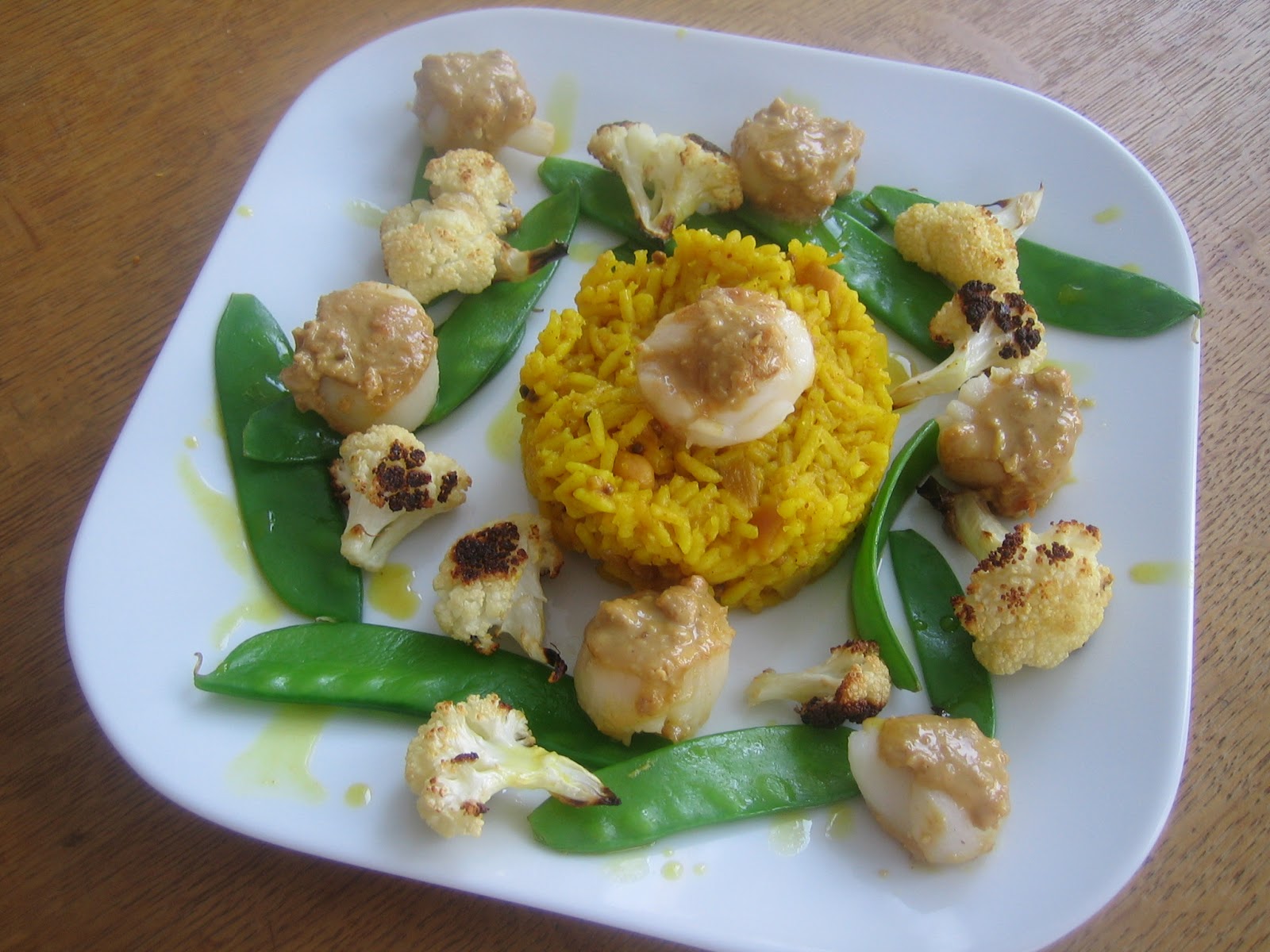

Two hours later and only most of the pots in my kitchen sullied (what did I DO with all that time?), I concluded that even a simplified Thomas Keller recipe was more than I wanted to do for a weeknight dinner.  But hey, it sure looked pretty, and it was quite tasty except for the fact that the recipe had the vegetables finishing way before you're ready to use them.  I've modified the recipe here to hopefully get everything to the table still warm. 

I was unable to find large sea scallops on the day I made this, but I recommend them if they are available.  That gorgeous, spicy rice recipe will come later this week.

Seared Scallops with Peanut Sauce
Adapted from Food & Wine Magazine, January 2012

2 tsp. hot curry powder
1/4 cup extra-virgin olive oil
2 tbsp. fresh-squeezed lime juice
1/2 lb. cauliflower, cut into small pieces
6 oz. snow peas, trimmed
2 tbsp. panko crumbs
1/4 cup plus 2 tbsp. crunchy peanut butter, preferably natural
1 1/2 pounds sea scallops, preferably large
Kosher salt and fresh-ground pepper to taste

Preheat the oven to 450 degrees.  In a small jar or bowl, shake or whisk together the curry powder and olive oil.  Let this sit for at least 15 minutes, or until the curry settles at the bottom.  Then strain through a coffee filter so the curry is removed, leaving you with just the oil.  Stir in the lime juice and add salt and pepper to taste.

Arrange the cauliflower on a baking sheet and drizzle evenly with two tablespoons of the olive oil.  Meanwhile, bring a small pot of water to a boil for the peas.

In a small skillet, warm one tablespoon of the olive oil.  When it is shimmering, add the panko crumbs and stir until they are slightly toasted, about three minutes.

Pat the scallops dry and season them with salt and pepper.  Place the cauliflower in the oven and bake until it is brown in spots, about fifteen minutes.  Place a large, oven-safe saucepan over high heat and add the remaining olive oil.

While the oil is heating, combine the panko crumbs with the peanut butter and stir to combine. 

When the oil is shimmering, add the scallops and sear them on one side for approximately four minutes.  Then turn the scallops over and lightly sear for another minute;  then remove the pan from the heat and top each scallop with a dollop of the peanut sauce.

Place the saucepan in the oven for approximately two minutes, which should melt the peanut sauce.  Boil the snow peas for approximately one minute, then immediately drain and rinse in cold water.

Remove the scallops and cauliflower from the oven and plate immediately on a bed of the cauliflower and snow peas.  Once the scallops, cauliflower and snow peas are on the plate, drizzle with a little of the curry oil.  Serve immediately.

Serves 4 as a light main dish.


Thursday, September 8, 2011

On My Bookshelf: Michael Ruhlman and Kathleen Flinn

Hello, my name is Krista and I am a reader.

Can I get a collective "Hello, Krista"?

Thank you.  I have been doing a profane act over the last month, cleaning my cookbook shelves.  I have a handful of cookbooks I use all the time, a handful that are mostly aspirational (I'm looking at YOU, Thomas Keller.  No, not you, Ina Garten.  We're still good.  Kisses.) and some that see an occasional use.  In order to make space for newer, shinier cookbooks, I've been culling a few from the shelves.

No, the Keller cookbooks aren't going anywhere.  I still need cookbooks with pretty pictures and things I'm incapable of making.
I also have a shelf of food literature, because sometimes it's as much fun to read about food as it is to actually cook.  I mean, you can read about food at the gym or on a plane, but not so much actually cook in those places.

Cleaning and culling prompted me to re-read a couple of food literature books that are worth recommending to other foodies, Kathleen Flinn's The Sharper Your Knife, the Less You Cry and Michael Ruhlman's The Soul of a Chef.  These books make me want to go back to Paris, go to a top-tier cooking school and never become a professional chef.  Simultaneously.

Flinn's book chronicles a year in which she is downsized from her job in London, decides not to return to her native Seattle, moves to Paris to attend Le Cordon Bleu and gets married.  Although the book was published in 2007 before the financial downturn, it rings especially true in these uncertain economic times.  What would you do if you lost your job and could do the thing that most interested you?  In her case, she is reminded by her new beau that she said she always wanted to attend Le Cordon Bleu.  She packed her bags, moved to Paris with a semester of college French and took all three parts of the school's fundamentals course.  Flinn chronicles the extreme difficulty of the coursework, her relationships with her fellow students from far-flung lands and her struggles with the language with humor and the occasional recipe.  It's a fast, fun read.

Ruhlman's book is divided into three parts, the first of which covers the Certified Master Chef examination at the Culinary Institute of America.  The second covers a chef from Ruhlman's hometown of Cleveland, Michael Symon, as he starts his restaurant Lola.  The final section covers the rise of Thomas Keller from teenager to the owner of the famed French Laundry (the book was published well before he opened his subsequent restaurants). 

Full disclosure:  I've eaten at French Laundry and while I appreciate what Keller does, it's not my favorite kind of dining experience--too fussy, and David and I felt like we had to be on our best behavior.  The dining room had a hushed atmosphere that wasn't conducive to relaxing and enjoying the food.  It just didn't feel fun, plus the tasting menu was too much food even for David, and that's saying something.  Ruhlman is downright reverential about Keller, and while I enjoyed knowing how Keller came to be one of this country's most famous chefs, I didn't feel like it merited a hundred pages.

The Michael Symon section is more interesting, if for no other reason as an example of a kitchen that is run more casually than Keller's.  What I take from this section is how hard it is to open a restaurant, please the public AND the critics and produce food that is consistently true to the chef's vision.

But the first section is easily the best.  Seven established chefs spend ten days at the CIA's Hyde Park campus taking cooking tests on specific skill sets from classical French to nutritional to Asian cuisine.  This includes multiple days where they show up, receive a basket of food and have to design and prepare a menu from it within four to five hours.  This section is intense, a real knuckle-biter:  cooking as a high-wire act, or a suspense story.  I've read this book before, but when I reread this section I literally couldn't put it down.  Several of the chefs don't make it through the entire process, but the ones that remain at the end are distinct characters.  I won't spoil the story--you'll find yourself rooting for them.

I'm always looking for more food literature--if you have suggestions, sound off in the comments section.

Not a great photo of my kitchen, and a whole section of wine and cheese books is hiding behind the dining room table.