Food Buzz Badge

Showing posts with label Pasta. Show all posts

Thursday, August 23, 2012

Cucina Povera

I've been getting to work really early lately.  Part of it is being super-busy, which I love, but part of it is that I love being in the office when it is so quiet.  This morning I can hear the rain pounding on the roof.

We're on a downhill slide into fall here in Anchorage.  I've been meaning to take pictures of the transformation, which include a flock of Canadian geese gathering on the mud flats near my house and the blooming of the fireweed.  Alaska legend is you can tell how long it will be until winter by when the fireweed finishing blooming and then goes to cotton.

For the first time in a couple of weeks, I was home to make dinner last night.  On Golden Pond is fully blocked and going well, but the nights we aren't in rehearsal I'm usually staying late at work or running the errands that I haven't had time to do. 

Last night I was determined to make something delicious, simple and packable to take to work for lunch.  I am fascinated by the Italian concept of cucina povera--literally, poverty kitchen--not because of the financial aspect of it (we are fortunate in that regard), but because it means you make a delicious dish from basically nothing. 

This dish is so simple that I kept wanting to do something more with it, like adding anchovies, chicken sausage or olives.  In the end, I left it proudly unadorned, the way it was meant to be.  It originated in Puglia, the single food region I most want to visit in Italy and haven't had the opportunity to--yet.

Rigatoni with Bread Crumbs and Parmesan
Adapted from Lidia's Italy by Lidia Bastianich

1 eight-inch piece of white country bread--baguette, French, ciabatta
1/3 cup olive oil
4 large cloves of garlic, sliced thinly
1 lb. dried rigatoni
1/4 cup Italian parsley, chopped
1/4 cup good-quality Parmesan, finely shredded, with more for garnish if desired
4 small dried peperoncino peppers, crumbled
Good-quality finishing olive oil
Sea salt and freshly-ground pepper

Trim the crust from the bread and then pull it into crumbs with your hands.  The crumbs should be various sizes.

Start a large pot of water to boil for the pasta, adding at least a tablespoon of salt.

In a large skillet, heat the olive oil.  When it is shimmering, add the bread crumbs and garlic.  Toss the crumbs to coat them with the oil, and toss occasionally when cooking so that they brown and crisp.

When the water is ready, add the pasta and cook for about nine or ten minutes, until the pasta is al dente.  Reserve half a cup of the pasta water and drain the pasta thoroughly.  Then add it back to the pot and cover it until ready to use.

The crumbs will be ready when they are lightly golden and crispy--make sure not to scorch the garlic.

Toss the pasta with a little of the cooking water to coat it.  Add the crumbs, parsley, peperoncini and Parm to the pasta and toss thoroughly.  Season with salt and pepper, then drizzle with good-quality finishing olive oil and toss again.


Serve with another grating of Parmesan.  Makes six appetizer pasta servings or four generous main course servings.  I served this with a side of fried zucchini and a bottle of dry, minerally Gruner Veltliner.

Monday, June 4, 2012

To Rome, With Love

Yesterday, I actually got to see a movie.  In the theatre.  This happens less often than you would think.

One of the previews was for the new Woody Allen movie, To Rome with Love, which was apparently shot there last summer.  It stars Roberto Begnini, the Italian comedian who was the lead in Life is Beautiful, a movie I thoroughly disliked.  It's been more than ten years since it came out and I still can't believe it won an Oscar.  But I digress.  It doesn't necessarily look like a movie I like, but the shots of Rome were gorgeous.

David and I spent four days of our vacation in Rome, which is an unruly mixture of the ancient and modern.  You walk down a street of little restaurants and shops, and boom, there's the Colosseum.  You turn the corner from an equally modern street, and there are the Baths of Caracalla.  The latter of which closes promptly at 1 p.m. every single day, BTW, and woe to those who show up at 12:45. 

We had a couple of spectacular meals in Rome, which I will post about separately, but it's mostly not the major tourist sites that will stay with me, but things like the Borghese Gallery.  Unlike the Vatican museum, which was absolutely overrun with tour groups, the Borghese allows only a very tightly controlled number of people in at once and features spectacular art set in the gorgeous villa for which much of the art was purchased.  The villa is set in large, beautiful gardens and was one of the highlights of our time in Rome.  Tickets sell out several weeks in advance--if you're planning a trip to Rome, buy them once you know your dates.

There are certain sites in Rome that look exactly as you have seen them in movies and in photographs, the Colosseum foremost among them.  Then there are places that you've never seen, like the former Jewish Ghetto and the (still active) synagogue there.  If you have any interest in Jewish or Holocaust history, this is a must-stop place and is surrounded by a still active Jewish quarter full of small kosher restaurants.  The food was so good that David and I returned to one kosher meat restaurant for a second lunch.

That salad in the background is the bomb
It's coming at you later this week.

Since we arrived home six days ago, we've been eating a lot of Italian-style food.  For our anniversary a couple of months ago, David bought me another Lidia Bastianich cookbook, Lidia's Italy, in which she picks her favorite spots in Italy and provides recipes specific to that area.  This very simple pasta takes less than twenty minutes if you don't make your own pasta. 

At a restaurant in Emilia-Romagna, the homemade pasta had a gorgeous golden yellow color.  We asked the chef about the color, and he said that he simply doesn't use the egg whites.  David had to give it a try last night.  The color and texture were great, but it does yield a slightly stickier dough.

Pasta Cacio E Pepe
Adapted from Lidia's Italy

1 1/2 tbsp. whole peppercorns, coarsely ground
3/4 lb. fresh pasta or dried spaghetti
1 cup finely grated Pecorino Romano cheese
Extra-virgin olive oil (optional)

Boil a large pot of salted water for the pasta.  Depending on whether you are using fresh or dried pasta, cook either very briefly for the fresh or until just al dente for the dried.  Drain the pasta, but reserve a cup of the pasta water for tossing.

Put the drained pasta into a large bowl and toss with the cheese and pepper;  it will likely be very dry, so drizzle in the pasta water and a little olive oil until the cheese coats the pasta.  Adjust by adding more pepper, cheese or oil to taste.

Serve immediately.  Makes four small main course servings;  could serve six as a pasta course.

Monday, April 16, 2012

Welcome Back, Carbs

The weekend started with promise:  theatre, friends and all day Sunday with nothing on the schedule.  Nothing.  It was the strangest thing, but I drew up a to-do list and we plunged in. 

Cue:  Monday morning with most of the to-do list left undone.  I swear we did not sit around the house yesterday.  Really.

Passover ended at sundown on Friday, and I even waited until 9 p.m. to eat my first slice of bread.  That's really restraint on my part.  It also means that bread, pasta and rice re-entered our house in a big way over the weekend.  Exhibit one:  this hunter's pasta.

This recipe isn't perfect;  I added the peas according to the recipe, but they really could have waited until closer to the end of the process, so I've modified that in the directions below.  This isn't the pasta equivalent of haute couture--think of it as the pasta equivalent of a favorite pair of sweats--comforting and easy to make and eat.  I used a mixture of mushrooms, but you could easily go with just one type, probably the cremini or portobellos.  The more expensive shiitakes can't be tasted enough to justify the expense.

Welcome back, carbs.  How I have missed you.

Also, without being too cute about it, my beloved cat Ingrid was seventeen yesterday.  Here she is is "helping" David make pasta.  I promise this pasta was solely consumed by David and I, as I would not let the cat sit that close to pasta I was making for guests.

 Rigatoni, Woodsman Style
Adapted from Lidia's Italy in America by Lidia Bastianich

1 tsp. sea salt
1 pound dried rigatoni
3 tsp. extra-virgin olive oil
1 medium yellow onion, coarsely chopped
1 lb. Italian chicken sausage, removed from casings
1/2 lb. cremini mushrooms, sliced thickly
4 oz. shiitake mushrooms, sliced thickly
1 large portabello mushroom cap, sliced thickly
6 fresh sage leaves
28 oz. can whole Italian plum tomatoes
1 cup frozen peas
1 bunch green onions, white and dark green parts only, chopped
1/2 cup heavy cream
1 cup good-quality Parmesan cheese, grated

In a medium bowl, crush the tomatoes by hand into small chunks and set aside.

Put on a large pot of water for the pasta and add a pinch of salt. 

Using a large skillet, heat the oil over medium heat.  When the oil is shimmering, add the onion and cook until the onion is slightly translucent, about three minutes.  Then add the sausage and cook thoroughly, using a wooden spoon to further crumble the meat.


Add all the mushrooms at once to the skillet, and cook for an additional two minutes.  Add the sage and tomatoes and bring the mixture to a simmer.  If the sauce is too thick, add a cup of water and return to a simmer.

Hopefully by this time your pasta water is at a boil;  add the rigatoni and cook according to the package until the pasta is al dente.  This should take about ten minutes.  Drain the pasta, reserving up to a cup of the pasta water in case the sauce needs thinning.

Cook the sauce uncovered for approximately ten minutes, then add the green onions and cook until they wilt into the sauce.  Add the cream and stir the sauce thoroughly to incorporate.  If the sauce is too thick, then add the pasta water bit by bit.  When the sauce is almost finished, add the peas and cook just until they are firm but not mushy.


Transfer the pasta to a warmed serving bowl, then add the sauce and toss thoroughly to coat.  Sprinkle some of the Parmesan over the bowl and serve the remainder on the side.

Makes 6 to 8 main-course servings;  could make up to 10 to 12 pasta course servings.

Friday, February 24, 2012

The Grail of Ingredients

Looking back at my first blog entries, I kind of want to cringe.

I didn't even sound like myself, but some weird, stilted version of myself.  I appear not to have had a sense of humor when I blogged about how I wanted to learn to cook serious Italian food and planned to use two cookbooks to guide me when doing it.  They aren't even my go-to cookbooks these days.  Sigh.

A16 Food + Wine is a great cookbook, don't get me wrong, but it assumes that you have all day to cook your dish and the bounty of San Francisco's markets at your fingertips.  

When my parents came up to visit at the end of last summer, I gave them a short list of some of the more esoteric ingredients to see if they could wrangle them at one of St. Louis' old-school Italian markets since St. Louis has a great old Italian neighborhood (for an entry about exploring that neighborhood, go here).

There was one ingredient that stumped even those markets:  bottarga.

Funny, it doesn't look like it's worth its weight in gold.
Bottarga is, according to A16, pressed mullet or tuna roe, although it now appears that it can be made of the roe from other fish.  I finally encountered it shaved over a salad at the restaurant Beast in Portland.  There's no mistaking it once you know what it tastes like:  salty and of the sea somehow.  Salmon roe has a similar taste, although it's not as intense as caviar.  You either like it or you don't.

Last Sunday morning before leaving Seattle, David and I stocked up on all things Italian at DeLaurenti's, a terrific Italian grocery at Pike Place Market (the coffee bar there, FYI, is terrific).  There, in the case with the salumi and cheese, was a hunk of bottarga.  I practically expired at the price, which was over $200 a pound or some such craziness.

We bought a tiny piece and brought it home to experiment.  This recipe from A16 is marked by its relative ease, although it assumes you have made your own oven-dried tomatoes.  I have adapted it to use storebought sun-dried tomatoes.  The bottarga is unnecessary to enjoy the dish, and vegetarians could leave it out. 

Pasta with Sun-Dried Tomatoes and Bottarga
Adapted from A16 Food + Wine

1/4 cup extra-virgin olive oil
3 cloves garlic, crushed
3 small peperoncini peppers, crushed
2 cups sun-dried tomato halves, cut in half
1/2 cup vegetarian or chicken stock
12 ounces fresh or dried pasta, preferably angel hair or bucatini
1/2 oz. bottarga

Put a large pot of salted water on to boil for the pasta.

Heat a large saucepan over medium heat, then add the olive oil.  When the oil is warm, add the garlic and peperoncini, stirring occasionally, until the garlic just starts to take color.

If using dried pasta, put it on now and cook until al dente.  Add the tomatoes to the saucepan and cook, stirring occasionally, for about ten minutes or until they have softened considerably.  About halfway through the cooking process, add the stock.

If using fresh pasta, start it now and cook for approximately a minute.  When the pasta, either fresh or dried, is cooked, reserve about a cup of the pasta water.  If the tomato mixture looks dry, add a couple of tablespoons of the pasta cooking liquid to reach the desired consistency, just thick enough to coat the pasta.

Combine the cooked pasta with the sauce and toss to coat the pasta strands.  Shave the bottarga over the pasta when it is either on a serving platter or in individual bowls.


Makes four main-course servings or six pasta course servings.

Monday, January 23, 2012

Working for the Weekend

Do you ever feel like you need a weekend to recover from your weekend?  Because I sure do.

I don't know when weekends began to feel so jammed, but between four performances of Love, Loss and What I Wore, working for a bit yesterday, holding auditions for the next show I'm directing, cleaning the house and exercising, I lost my weekend.  Where did it go, and could I have it back please?

The only time I managed to slow down was when I got home from the theatre yesterday.  Free time--what's a girl to do?  Why cook, of course.  David was still hunkered in the living room watching the football game and I had the kitchen all to myself--though to give full credit to David, he cranked out homemade linguine noodles when the game was over.

A good smattering of Pecorino Romano on the pasta is a nice finish.

As an aside, does anyone have a good recipe for wasabi aioli?  The Love, Loss cast went out after the show on Saturday to Ginger, a sort of Asian-fusion restaurant around the corner from the theatre.  I don't love all their food, but they have fabulous appetizers.  The pommes frites with wasabi aioli are to die for.

The following recipe is the compromise for what I had originally intended to make.  Lidia Bastianich's recipe contains pistachios rather than walnuts, but the local grocery store was out of pistachios.  Seriously?

Consider this a tease for Wednesday's post;  that
stuffed eggplant in the background is AH-MAZE-ING.

Play with the seasoning on this.  I wanted a little zip and added dried peperoncini, but they're not necessary.  I added a little more garlic to the original recipe because I thought it didn't have enough oomph;  pare back to eight cloves if you're a little more tentative with your garlic.

This recipe makes quite a thick paste;  once you've finished cooking the pasta to go with it--I recommend either linguine or spaghetti--reserve a cup of the pasta cooking water to thin the sauce to the desired consistency.

Basil-Toasted Walnut Pesto
Inspired by a Recipe from Lidia's Italy in America by Lidia Bastianich

3 cups basil leaves
1 cup Italian parsley sprigs
1 cup walnuts, toasted
6 tablespoons olive oil
2 small peperoncini
8-10 cloves garlic, peeled
1/2 tsp. kosher salt
Pasta cooking water

All all ingredients except for the olive oil and cooking water to the bowl of a food processor.  Pulse the mixture until it is a very thick paste, then drizzle the olive oil in tablespoonful by tablespoonful.  As noted above, this will make quite a thick paste that you will need to thin with either pasta cooking water or even chicken stock.

Isn't that green just gorgeous?
This makes lots of pesto, enough for about two pounds of pasta.  The leftover pesto can be stored in the refrigerator or frozen.


Thursday, January 5, 2012

Love, Loss and What I Ate

I've been scaring people at the gym a little this week.

I agreed to be part of a reading called Love, Loss and What I Wore, which is a collection of scenes and monologues about women and their clothes.  It sounds fluffy--and it kind of is--but there is some truth to the idea of that we are what we wear (as well as what we eat).

But back to scaring people at the gym--I have been running lines while on the elliptical machine.  Mind you, I'm not saying them out loud, but I'm reading and thinking through them, and gesture a little like I plan to do in the show.
I don't act much anymore, since I keep getting offers to direct shows.  There are two problems with getting back onstage after spending a couple of years sitting in the audience giving others direction.  First, acting is terrifying when you haven't done it for a while.  It is no easier when you're onstage with actors you admire who are capable of making anything funny.  The other four women in this show are a formidable, talented bunch.

This also means I'm not home to cook every night, which I was kind of getting used to before I agreed to do the show.  Monday night was my last night off before I plunged into a week of rehearsals, as well as being the last evening of a three-day weekend, so I wanted to make something special.


And, make no mistake, this pasta is special.  Slightly spicy, full of wilted dark leafy greens and thickened with toasted bread crumbs, the sauce is a winner.  David made homemade linguine to eat with it, but good-quality dried pasta will work just as well.

Pasta with Sausage and Kale
Adapted from The Mozza Cookbook by Nancy Silverton

1 small bunch Lacinato kale
1/4 cup olive oil
1/2 medium yellow onion, chopped
6 garlic cloves, sliced
2/3 cup water
3/4 lb. Italian chicken sausage, removed from its casings and coarsely chopped
2 small peperoncini peppers, crushed
1 cup low-sodium chicken stock
1 tbsp. unsalted butter
12 oz. fresh or dried pasta
1 tbsp. good-quality extra-virgin olive oil to finish the sauce
1/4 cup Parmesan cheese, finely grated
2 tbsp. bread crumbs, toasted
Kosher salt and fresh-ground black pepper to taste

Wash and dry the kale.  Cut the leaves away from the stems and chop the stems into 1/2 inch pieces. 


In a large, deep skillet, heat the quarter cup of olive oil over medium heat.  Add the kale stems and cook for two to three minutes, or until they are softened.  Add the onion and garlic and sprinkle with a small amount of salt.  Then add the water and cook this mixture until the vegetables are thoroughly tender but not mushy, about ten minutes.  You will need to stir this mixture as it gets to the end of the cooking time to prevent the vegetables from sticking to the pan.

Add the kale leaves and cook for an additional one to two minutes, stirring them into the stem mixture.  Then reduce the heat to low and cook this mixture for another fifteen minutes, stirring occasionally.  The mixture is done when it is very soft and thoroughly wilted.


Empty the skillet onto a cutting board and allow the vegetables to cool.  Start the pasta water at this time;  if you are using dried pasta, cook to al dente;  if you are using fresh pasta, it will only take a minute or to to cook.

Using the same skillet, heat it over high heat, add the tablespoon of olive oil and then add the sausage.  Allow it to cook without being stirred for about two minutes, or until the sausage is thoroughly browned.  Then stir the sausage, breaking it apart into even smaller chunks, reduce the heat to medium and cook for another four minutes.

I added a bit more onion to the sausage, but this isn't necessary.

While the sausage is cooking, chop the kale mixture very finely.  You will use most of it in the pasta, but we served the leftover vegetables on the side--they taste like a steakhouse creamed spinach dish, but way healthier.

Add 3/4 cup of the kale mixture to the sausage and stir to combine.  Add the peppers and cook for another two to three minutes, then add the stock and reduce the heat to a simmer.  You will need to stir often to prevent the sauce from sticking.

Add the tablespoon of butter, sprinkle in the cheese and stir to combine these ingredients with the sauce.  Add the bread crumbs and stir again--you should have a lightly thickened sauce.

Toss with the pasta to combine.  Add salt and pepper to taste.

Serves four.

Friday, December 23, 2011

Sisterhood of the Traveling Menorah

It's Chrismukkah in Cucina49.  What's Chrismukkah, you say?  It's what David and I name the rare holiday season where Hannukah and Christmas collide.

Jewish holidays are on a lunar calendar, so Hannukah can fall anywhere in December.  There are years it's started at the very beginning of December, and years when it is at the very end.  This year it started at sundown this past Tuesday night, which means it's a Chrismukkah year in our household.


In the lobby of Cyrano's 
on the second night of Hannukah.

It's been a busy week with the closing of the wonderful, sold-out run of Inspecting Carol tonight and the start of rehearsals for my next project, along with helping out at a theatre whose board I sit on.  The main Hannukah ritual is lighting a menorah each of the eight nights, so I've started a project I call "The Sisterhood of the Traveling Menorah," where the menorah has come with me for the past couple of nights to wherever my evening commitment has been.  Have menorah, will travel.


Backstage at Inspecting Carol on the third night of Hannukah. 


Before I share one of my favorite recipes from this holiday season, I want to thank my friends and fellow bloggers who have read, commented upon and advised on this blog, which is just five months old.  I've loved hearing from all of you and value your input.  A special thanks to two bloggers who have sent me virtual kudos over the past month:  Curry and Comfort, a fabulous blog specializing in international food and particularly the food of India, which awarded me a "Versatile Blogger Award," and Gluten Free Food, a blog that makes living gluten-free look very tasty, which awarded me a "Fabulous Blogger Award" earlier this week.  Thank you Ramona and Balvinder for the kudos!

I've made the following recipe twice in the last month and will likely make it again in an appetizer version for our big Chrismukkah dinner on Sunday.  You can vary the meats used in the meatballs to suit your taste, but this is one of those moments when (ahem) I'm going to ignore a little pork working its way into the food. 


Mama Lidia's Meatballs
Adapted from Lidia's Italy in America by Lidia Bastianich

I used crumbs I made from a stale loaf of rosemary bread,
which added another layer of flavor.
2 pounds 80% lean ground beef
1 pound ground mild Italian sausage
2 cups breadcrumbs, preferably fresh
1/2 cup parsley, chopped
1 large carrot, coarsely chopped
2 cloves garlic, coarsely chopped
2 stalks celery, coarsely chopped
1 medium yellow onion, coarsely chopped
1 tsp. truffle or kosher salt
1 tsp. fresh-ground black pepper
2 large eggs

Preheat the oven to 425 degrees.  Once the oven comes up to temperature, toast the breadcrumbs for two to three minutes if you are using fresh ones (which I highly recommend).

 Prepare two large cookie sheets by lining them with parchment paper.

Place the carrot, celery, onion and garlic in the bowl of your food processor and pulse until the vegetables are almost liquefied. 


In a large bowl, combine the meats with your hands until thoroughly mixed.  Add the vegetable mixture, salt, pepper and breadcrumbs and mix again.  Beat the eggs in a small bowl and add them to the mixture, along with the parsley.  Mix again with your hands to combine the ingredients thoroughly.


Shape the mixture into balls with your hands.  You can vary the size of the meatballs--this recipe makes at least 48 large ones or 96 small ones. 


Bake for approximately eighteen to twenty minutes, depending on the size of the meatballs you are making.  This will result in a par-baked meatball that can then be finished while cooking in a sauce.  For a thoroughly cooked meatball, bake for another two minutes.

 
Serve with pasta or as an appetizer with a mustard or marinara sauce on the side.

Tuesday, December 6, 2011

Slaying the Food Dragon

Everyone has a food goal.  A quest.  A grail, if you will.  That thing that you want to make that you feel that you don't have the skills to do.  David calls it "slaying the food dragon."


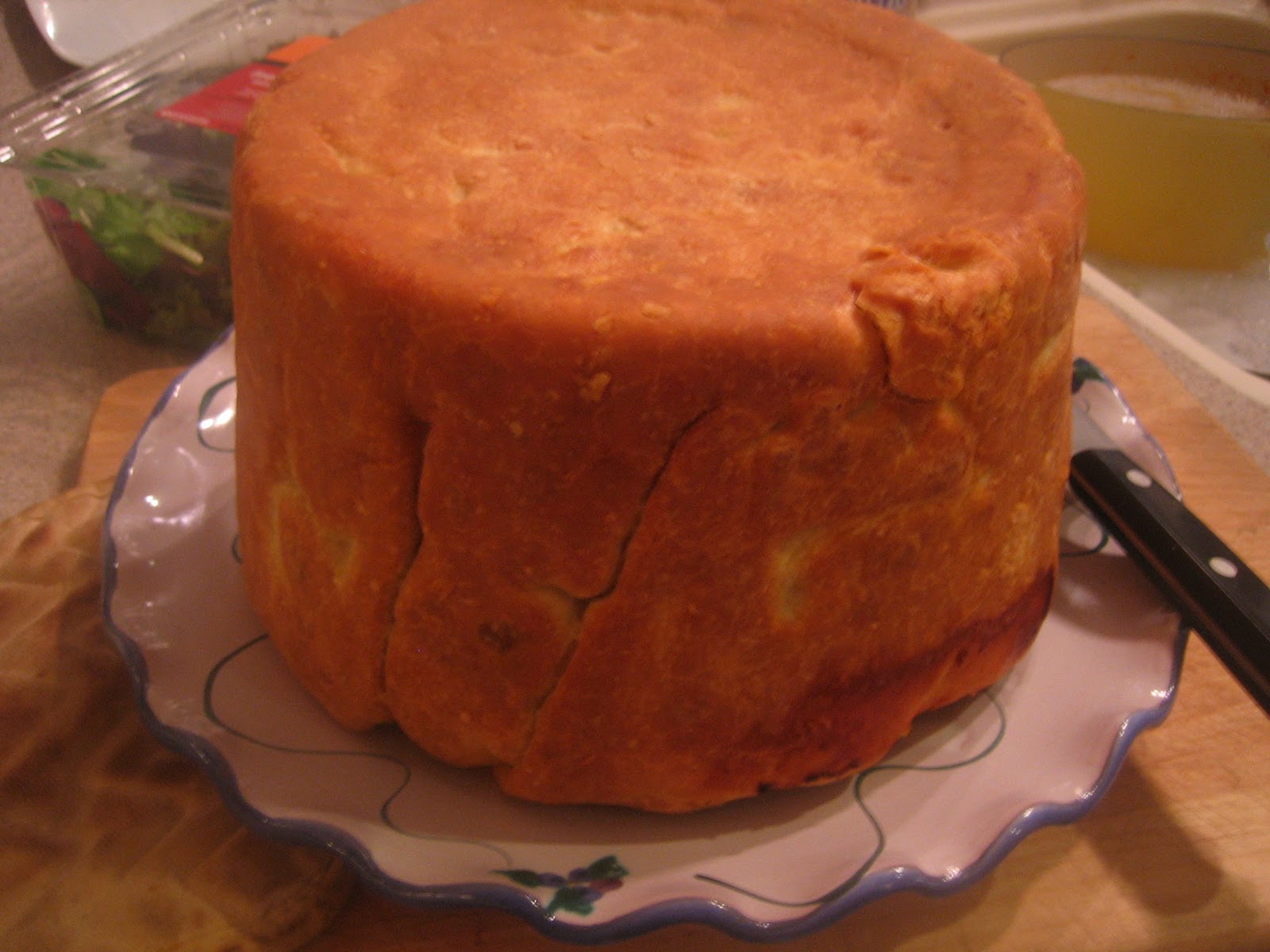
For lovers of Italian food (me) and movies (me again), that food dragon is the timpano, the dome-shaped pasta baked in a ceramic basin and filled with layers of pasta, ragu, meatballs, chunks of cheese and salami and hard-boiled eggs that features in the long dinner party scene at the center of the terrific movie Big Night.  If you love food--and if you're reading this I have to assume that you do--then you owe it to yourself to see this movie about two Italian brothers trying and failing to run a restaurant serving traditional food in 1950s New Jersey.


Ever since I first saw this movie in 1997, I have wanted to make the legendary timpano.  For my birthday this year, David bought me a pan that he asserted was for us to finally make it.  Six weeks passed, and this past weekend we were planning a big cast and crew dinner for Inspecting Carol on Sunday night.  During the week I said, "why don't we make the timpano?"

We hemmed and hawed and looked at recipes.  There's no doubt that it is a lot of work.  You make a pasta dough for the shell, the ragu and meatballs for the filling.  Lots of cutting and slicing and precision work.  But in the end, we just went for it.


These were adapted from a recipe by Lidia Bastianich, and they were the bomb.  More on them to come.

Revelation:  it's not that hard.

Yes, it's a lot of work, and I will keep tweaking the recipe before I blog about making this.  The ragu wasn't quite right, and the dough for the shell needed to be thinner.  For those who are curious about what it entails, I found this one on the internet.  The one we used is a little different, and more closely approximates the one in the movie, which is an adaptation of actor Stanley Tucci's family recipe. 


I did love the meatball recipe I used and adapted, which I will blog about separately this week.  In the interim, what I'd love to know is this:  what is your food grail?  I look forward to hearing!

Saturday, October 29, 2011

Slouching Toward Winter

It has been a long week here, I'm telling you.

It began with not feeling great and hit an apex midweek when one of the actors in my play called me at 10:30 at night to say that he hadn't realized the show performed on Saturday nights and he had another gig on Saturdays.  Really?  Really?  I don't think it takes being a theatre person to know that in theatres all around the country--nay, all around the world--shows perform on Saturday nights.  But okay.

It didn't help that this was the most difficult role to recast.

Then, as I was leaving my office for a meeting on Thursday afternoon, my car wouldn't start and it had to be towed off to the shop when it became clear that it was not just a dead battery.

I'm pleased to say that things started looking up yesterday.  I'm feeling better, we found a new actor and it turns out that my car battery was cracked and needed to be replaced--sure, not great, but better than the dead alternator that all the lawyers in my office predicted it was.  (As an aside, a clump of lawyers standing in a parking lot in the middle of the afternoon prognosticating on what is wrong with a car while said car is being towed makes for great comedy.)

I even had last night off and practically didn't know what to do with myself.  Who am I kidding?  I was going to cook.


It is, amazingly enough, still fall in Alaska.  Parts of Anchorage in the upper elevations have had a dusting of snow, as has one of the suburbs.  At my house, there's been a hard frost in the morning for a couple of weeks now, but no actual snow. 

I'm calling this recipe "Yearning for Summer" pasta because it has the flavors of summer but doesn't rely on ingredients only available in summer.  If you still have access to fresh corn, knock yourself out and use that.

Yearning for Summer Pasta with Herbs and Ricotta
Adapted from Bon Appetit Magazine, June 2008

1 large head of garlic, with the top 1/2 inch removed
4 tbsp. extra-virgin olive oil
1 10 oz. bag of frozen corn, thawed
4 tsp. grated lemon or lime zest
6 tbsp. fresh lemon or lime juice
12 oz. dried capellini (angel hair) pasta
1 large leek, white and pale green parts only, chopped
4 cups mixed greens (arugula, radicchio, baby spinach)
1 cup fresh part-skim ricotta cheese
1/2 cup grated parmesan
1 cup finely chopped mixed herbs (basil, chives, parsley--use whatever is in your refrigerator)
Kosher salt and freshly-ground pepper

Preheat the oven to 400 degrees.  Take a large piece of aluminum foil and place the garlic in the middle.  Drizzle with two tablespoons of the olive oil and sprinkle with salt and pepper.  Wrap the bulb in the foil and place in the center of the oven.

While the garlic is cooking, spread the frozen corn on a baking sheet that has been sprayed with a nonstick spray.  Set a large pot of salted water on to boil.

After the garlic has been cooking for fifteen minutes, place the baking sheet with the corn in the oven.  Bake for another fifteen minutes, then sprinkle the leeks over the corn and return to the oven for another ten minutes.

Even frozen corn tastes so much better after it's been roasted.
Remove the baking sheet from the oven.  The garlic should be soft at this point, and the corn and leeks should be lightly roasted.  Carefully (it will be hot!) squeeze the garlic out of its husks and add to a medium bowl.  Mash the garlic a bit, then add the remaining two tablespoons of olive oil, plus the zest and juice.  Stir the mixture--it will be thick.

This is so good that you might need to have a bite or two before adding it to the pasta. 
Just to test it, you know.
Cook the pasta until al dente and drain, reserving a cup of the cooking water in case it's needed to thin the sauce.  Return the pasta to the pot it was cooked in and add the greens, parmesan and garlic sauce.  Toss to coat the pasta, adding a little of the pasta cooking water if necessary to thin the mixture.


Transfer the pasta to a warmed serving bowl, season with salt and pepper and serve with additional parmesan if desired.

Serves four as a main course;  six as a pasta course.

Food/wine pairing:  Serve with a wine that will pick up the flavors of the citrus--American or South American Sauvignon Blanc or Vinho Verde.

Thursday, October 13, 2011

Back to School

I like school, other than the fact that I have nightmares about it.

That's not totally true.

I like learning, particularly about things that help me out not at all in the real world.  Offer me a class about cooking, wine, theatre or literature and I'd be there.  I'm convinced that I'm going back to school to either become a chef or a sommelier later in my life.

It's just math classes and not remembering my locker combination that feature in my nightmares.  A psychologist could almost certainly have a field day with this, but occasionally I have nightmares about being unable to remember my locker combination, failing a math test or forgetting to drop a class until the end of a term.  Hmm.

But I do love learning, and with this in mind I went to check out a new-ish cooking school on Tuesday night and dragged David (quite a good cook in his own right) with me.  I wasn't sure what to expect, other than the class was Italian Food.

The problem was that it was cooking for beginners, which was great for most of the people there.  The instructor was friendly and boiled things down to the basics, but once I caught that there wasn't much to be learned I played around with making the perfect puttanesca sauce.  I make sauces all the time that are almost puttanesca, but this time I was going to follow the recipe to the letter.  Except, you know, for adding an extra anchovy, which I totally recommend.

Fun fact:  puttanesca means "like a whore" and is named for the dish that (ahem) prostitutes would make between clients.

The photos show sauce for one, but I've quadrupled it for a standard size recipe.

Too-Easy-For-Words Puttanesca Sauce
Adapted from Let's Cook Alaska and epicurious.com

4 cloves garlic, chopped
8 anchovies packed in oil, rinsed and chopped
4 cups good-quality crushed tomatoes
1/2 cup chopped black olives
2 tbsp. capers, drained
2 tbsp. fresh oregano, chopped or 1 tbsp. dried
1/2 tsp. hot red pepper flakes
1/4 cup olive oil
12 oz. dried spaghetti
Kosher salt and fresh-ground pepper

Start a large pot of water boiling for the pasta;  when it reaches a boil, salt it well and add the pasta.

Add the olive oil to a large saucepan over medium heat.  After a minute, add the garlic, anchovies, red pepper and a pinch of salt.  Sauté for up to two minutes, until the garlic is just golden.  Be careful not to overcook.


Add the crushed tomatoes, breaking up the chunks with a wooden spoon, along with the olives and capers.  Turn the heat to low, add the oregano and cook, stirring occasionally, while the pasta cooks.


When the pasta is done to your taste (I prefer mine al dente, which usually means less than 10 minutes boiling time), drain well and add to the saucepan.  Toss with tongs and add salt and fresh-ground pepper to taste.

Sorry for the blurry quality of the photo;  the light was not good in the dining room.  The chopped salad was terrific--I'll post that recipe soon, too.
Serves 4 people, or 2 with plenty of leftovers.

Variations:  For a strictly vegetarian dish, omit the anchovies.  If you are a cheese lover, you could grate fresh parmesan over the pasta.

Food/wine pairing:  Chianti, baby.

Tuesday, October 11, 2011

A Meal Worth Coming Home To

It's been an eventful five days since I last wrote on this blog.

On Sunday, I did the Portland Marathon with my friend Paul.  It wasn't our best time, but it was a good race and I will take any excuse to travel to Portland.  I tried three new restaurants, made two pilgrimages to my favorite bookstore and decided--again--that I was going to retire from doing marathons.  I'll still do half-marathons, but the training for a full marathon takes up valuable cooking, reading and writing time.  We'll see if I stick to it.

As much as I love eating in restaurants--and I love going to new restaurants--it was nice to cook again last night.  Which is a good thing, since today the new appliances arrived and it looks like some sort of war (what would a kitchen war be called, I wonder?  Discuss.) broke out in my kitchen.


This dish could easily be doubled, and don't skimp on the marinating time for the prawns--you can work on something else during that half an hour.  If you're feeling adventurous and it's more than 40 degrees outside at night, you could cook the shrimp on an outdoor grill.


Post-Marathon Prawns and Saffron Orzo
Adapted from Bon Appetit Magazine, June 2011

For the prawns:
1 lb. prawns or large shrimp, in their shells
3 tbsp. extra-virgin olive oil
2 garlic cloves, minced
1 small peperoncino dried pepper, or 1/4 tsp. crushed red pepper flakes
1.5 tbsp. low-sodium chicken broth
1 large fennel bulb, thinly sliced and with fronds reserved
Sea salt and fresh-ground black pepper
1 small head radicchio
2 tbsp. fresh lemon juice

For the orzo:
1 pinch saffron
2 cups low-sodium chicken broth
1 cup orzo pasta
Sea salt and fresh-ground pepper

Put the pinch of saffron in a small bowl with 2 tablespoons hot water and set aside to steep.


Heat one tablespoon of the olive oil in a small sauté pan over medium heat;  add garlic and red pepper and cook for about 30 seconds or until the garlic is light brown.  Keep an eye on this, because the garlic can scorch very quickly. 

Cut the fennel fronds from the stems, and chop enough to equal 1 tablespoon.  Pour oil mixture into a medium bowl, add the fronds and chicken broth.  Stir in salt and pepper to taste.

Cut a slit in the back of the prawns and devein if desired.  Add the prawns to the oil mixture and toss.  Marinate at room temperature for half an hour.

Remove the outer leaves of the radicchio and slice thinly.  Toss the fennel bulb and radicchio and set aside.


For the orzo, put the chicken broth on to boil and add the saffron with its steeping water.  When the water has boiled, add the orzo and cook for up to 12 minutes.  It will need a minute or two less if you'd prefer it al dente.

Heat an indoor grill or panini pan to high.  While it is heating, drizzle lemon juice and last tablespoon of oil to the fennel/radicchio mixture.  Add a little salt and pepper and set the salad aside.

Grill the prawns for two minutes on each side, brushing with the marinade.  The shells should take on a caramel color and the prawn meat will turn bright pink.  Don't overcook--prawns are too good to be tough.


Plate the salad greens and arrange the prawns over them.  Serve with a side of orzo.

Makes enough for two people with leftovers.

Food/wine pairing:  Serve with a lively, bright white wine such as Sauvignon Blanc, Vinho Verde or Viognier.