Food Buzz Badge

Showing posts with label vegetarian. Show all posts

Thursday, August 23, 2012

Cucina Povera

I've been getting to work really early lately.  Part of it is being super-busy, which I love, but part of it is that I love being in the office when it is so quiet.  This morning I can hear the rain pounding on the roof.

We're on a downhill slide into fall here in Anchorage.  I've been meaning to take pictures of the transformation, which include a flock of Canadian geese gathering on the mud flats near my house and the blooming of the fireweed.  Alaska legend is you can tell how long it will be until winter by when the fireweed finishing blooming and then goes to cotton.

For the first time in a couple of weeks, I was home to make dinner last night.  On Golden Pond is fully blocked and going well, but the nights we aren't in rehearsal I'm usually staying late at work or running the errands that I haven't had time to do. 

Last night I was determined to make something delicious, simple and packable to take to work for lunch.  I am fascinated by the Italian concept of cucina povera--literally, poverty kitchen--not because of the financial aspect of it (we are fortunate in that regard), but because it means you make a delicious dish from basically nothing. 

This dish is so simple that I kept wanting to do something more with it, like adding anchovies, chicken sausage or olives.  In the end, I left it proudly unadorned, the way it was meant to be.  It originated in Puglia, the single food region I most want to visit in Italy and haven't had the opportunity to--yet.

Rigatoni with Bread Crumbs and Parmesan
Adapted from Lidia's Italy by Lidia Bastianich

1 eight-inch piece of white country bread--baguette, French, ciabatta
1/3 cup olive oil
4 large cloves of garlic, sliced thinly
1 lb. dried rigatoni
1/4 cup Italian parsley, chopped
1/4 cup good-quality Parmesan, finely shredded, with more for garnish if desired
4 small dried peperoncino peppers, crumbled
Good-quality finishing olive oil
Sea salt and freshly-ground pepper

Trim the crust from the bread and then pull it into crumbs with your hands.  The crumbs should be various sizes.

Start a large pot of water to boil for the pasta, adding at least a tablespoon of salt.

In a large skillet, heat the olive oil.  When it is shimmering, add the bread crumbs and garlic.  Toss the crumbs to coat them with the oil, and toss occasionally when cooking so that they brown and crisp.

When the water is ready, add the pasta and cook for about nine or ten minutes, until the pasta is al dente.  Reserve half a cup of the pasta water and drain the pasta thoroughly.  Then add it back to the pot and cover it until ready to use.

The crumbs will be ready when they are lightly golden and crispy--make sure not to scorch the garlic.

Toss the pasta with a little of the cooking water to coat it.  Add the crumbs, parsley, peperoncini and Parm to the pasta and toss thoroughly.  Season with salt and pepper, then drizzle with good-quality finishing olive oil and toss again.


Serve with another grating of Parmesan.  Makes six appetizer pasta servings or four generous main course servings.  I served this with a side of fried zucchini and a bottle of dry, minerally Gruner Veltliner.

Wednesday, August 15, 2012

Goodbye Is the Hardest Part

We have all kinds of relationships in our lives...but a theatre director's relationship with a longtime stage manager?

Priceless.

For those who don't know what a stage manager does, it is the person who takes all the blocking notes, keeps the director on schedule, is the primary contact for the the designers (sound, costumes, lights, props) and, when the show opens, has the primary responsibility for making sure that it runs right and on time--and those are just the common duties.  The director hands the show over on the day it opens. 

It's a terrifying thing, or would be if I haven't been fortunate enough to have a small handful of stage managers who I also consider good friends and confidantes.

My friend Erika first stage managed for me when I directed my first professional show, Deathtrap, in 2007.  I would trust her with just about anything, and never had a second's hesitation about handing a show over to her on opening.  I've lost track of how many shows we've done together, but Sandy, the head of our local semiprofessional theatre company, calls us "the Dynamic Duo."

Eeks, it sounds like I'm eulogizing her, doesn't it?  It's not that.  Erika is heading off to a four-year program at a Russian Orthodox seminary to become a counselor.  She moves to Kodiak Island later this week.

It's a perfect fit of a profession for her, and I wish her all the best. 

David and I had Erika and Sandy over to dinner this past Sunday to say our goodbyes, or at least our "farewell for nows."  It was a lovely dinner, but of course bittersweet since we will really miss Erika.

For a first course, we served the Barefoot Contessa's salad with phyllo-wrapped goat cheese.  It's a stunning salad, even if my phyllo purses were not quite as pretty as the ones in the cookbook.  Make sure you serve the salad when the purses are fresh out of the oven.

Summer Salad with Phyllo Purses
Adapted from Barefoot Contessa Back to Basics by Ina Garten

8 sheets frozen phyllo dough, defrosted
8 tbsp. unsalted butter, melted
6 oz. log goat cheese
Baby salad greens (I used a spring mix, about 2 oz. greens per person)
2 1/2 tsp. champagne vinegar
1 tsp. coarse Dijon mustard
1 clove garlic, finely minced
1 tsp. kosher salt, plus more for serving
1/2 tsp. fresh-ground black pepper
1/2 cup extra-virgin olive oil

Preheat the oven to 375 degrees.  To prepare the phyllo purses, unroll the dough and set aside only what you need to use.  Cover the dough with a very lightly damp dishtowel--I ruined a couple of sheets of dough by using a towel that was too damp.


Trust me, they look so much better when browned.
Spread out one sheet of phyllo on a cutting board and brush all over with the melted butter.  Repeat with the remaining sheets of phyllo--you will want four sheets stacked on top of each other.  Cut the dough stack in half crosswise.

Cut the goat cheese log into discs about 1/4 inch thick.  Place two in the center of each phyllo section, then bring the sides of the phyllo square up to wrap around it.  The Barefoot Contessa compares it to wrapping a circular gift--you'll want to crimp together the top as much as you can, and get the dough as tight as possible around the bottom of each phyllo purse.

Repeat with the remaining phyllo--you will likely have some leftover goat cheese.

Spritz a small baking sheet or cake pan with nonstick spray and place the phyllo purses on it.  Bake for about twenty minutes, or until the purses are lightly browned.

In the interim, prepare the salad dressing by whisking the vinegar, mustard, garlic, salt and pepper in a small bowl.  Then whisk in the olive oil in a steady stream until the dressing emulsifies.

Place the greens in a salad bowl and toss by hand with a pinch of kosher salt, preferably flaked salt.  Then toss with the dressing until the greens are evenly coated.

Plate the salad with a small amount of dressed greens on one salad and one phyllo purse on the other.

Serves four, but could be easily doubled.

Thursday, August 9, 2012

Dazed and Confused

Some weeks I feel like I'm sprinting for Friday, full of energy and purpose.  This week I feel like I'm crawling.

It hasn't been a bad week, just an exhausting one.  Work has been super-busy (not that I'm complaining--better that way than the reverse), and we just blitzed through blocking twenty-four pages of On Golden Pond over the last two nights.

Somehow, David and I have no plans for the next couple of nights.  I'm kind of grateful.  I foresee a long walk in my future tonight, followed by a glass of wine and some of the good cheese here my parents schlepped from one of the Italian markets in St. Louis.

A totally random photo demonstrating what happens if one flops on the
bed in our household.  Ingrid considers you her personal chaise.
David is doing somewhat better after his rib-fracturing bike accident a couple of weeks ago, but he's not up to hiking or other outdoor activity yet, so I also foresee a solo hike in my future this weekend.

We also received the latest CSA box, which includes a bunch of one of my favorite veggies, Swiss chard.  I love the stuff but am forever trying to find new ways to prepare it.

This recipe might win over people who don't particularly like dark leafy greens--it is savory and just slightly cheesy, and it has a terrific combination of tender and crispy bits.  While the original recipe did not call for oiling the pan prior before placing the chard cakes in it, they wanted to stick without it.  I thought it sounded weird not to oil the pan, but who am I to overrule Lidia?  Learn from my mistake.

Crispy Swiss Chard Cakes
Adapted from Lidia's Italy by Lidia Bastianich

1 lb. rainbow chard
2 tbsp. good olive oil
1/2 medium yellow onion, thinly sliced
3/4 tsp. sea salt
1 1/2 tbsp. unsalted butter
1/4 tsp. fresh-ground black pepper
1 cup Parmesan cheese, finely shredded
1 egg yolk, beaten

Wash the chard and trim off the stems, then trim away the central ribs.  You won't be using these for the dish, but they are great slow-cooked with a little broth, oil and garlic.

Bring a large pot of water to boil over high heat, then add the chard leaves.  Continue to let the pot boil for about twenty minutes, or until the chard is tender.  Drain and rinse the chard under cool water, and then finely chop the chard.

Here's the step I can't emphasize enough--squeeze every drop of water you can out of the chard, or the cakes will fall apart. 

Heat a large skillet over medium heat and add the butter.  When it is melted, add the onion and half a teaspoon of salt.  Cook the onion until it turns lightly brown, then add the chard and remaining salt.  Cook another 7-8 minutes, until the butter has all been absorbed.  You will want the chard to be dry but not crispy.

Remove the chard from the skillet and let the skillet cool.  When it is cool enough to handle, wipe it absolutely clean. 

When the chard is lukewarm to the touch, combine it with the cheese and egg yolk.  Divide the mixture into small patties and press them together firmly.  If there seems to be too much liquid in the mixture, squeeze some out and start again.

Reheat the skillet over medium heat and add the olive oil.  When the oil is shimmering, carefully place the chard cakes in the skillet.  Cook for about three minutes per side, then drain on a paper towel.


Serve warm--should make about four large cakes or six small ones.  We served them with a grilled Florentine steak, though they would make a fantastic addition to a vegetarian meal.

Tuesday, July 24, 2012

Here Comes the Sun

The sun is out!

This wouldn't be such an occasion for celebration were it not for the fact that it has been gray and rainy since last Friday night.  My hiking shoes and I will be heading out after work.

Despite the gloomy weather, I haven't been cooking much over the past couple of weeks.  Part of it is the casting process for On Golden Pond, which sadly remains ongoing as I seek out the last person, plus long hours at work, but part of it is that I've been wanting to eat basically two things:  Mexican food and salad.

There have been lots of blogs lately extolling the virtues of quinoa, a chewy little grain that takes on the flavors with which it's surrounded.  I have nothing but love for it, especially since it's kosher for Passover (a huge discovery this year) and a complete protein.  It's good hot or cold, and pairs particularly well with summery fish dishes.

This salad would make a light main course or a perfect side--I served it with Nigella's mustard-coated salmon.  I've doctored it up to add some additional color and crunch from radishes.  The ones we get in Alaska are vividly colored and very peppery, and I can't resist them.  We ate this salad outside on a sunny night with a bottle of Italian white wine.

Quinoa Salad with Greens and Spring Onions
Adapted from Salad as a Meal by Patricia Wells

For the salad:
1 1/2 cups quinoa
3 cups vegetable or chicken stock
2 dried bay leaves
1 tsp. coarse sea salt
1 tbsp. lemon juice
2 cups parsley leaves, coarsely chopped
1 tbsp. good olive oil
3 small spring onions (or scallions, if spring onions aren't available)
5 oz. baby spinach
4 radishes, sliced thinly

For the dressing:
2 tbsp. lemon juice
1/2 tsp. coarse sea salt
1 cup 2% milk
1/3 cup chives, minced
Lemon zest

Toast the quinoa in a large saucepan over medium heat, shaking or stirring it regularly until it crackles, about five minutes.  Remove the quinoa from heat and rinse it in a sieve with cold water.

Return the saucepan to the stove and heat the stock to a boil.  Add the quinoa, bay leaves and salt, then reduce the heat.  Cover the saucepan and simmer for about 15 minutes, stirring occasionally.  Taste the quinoa to see how chewy it is and cook for an additional five minutes if it isn't soft enough.

Remove the quinoa from the stove and allow to sit for an additional ten minutes.  While it is cooling, whir the lemon juice, parsley and olive oil in a mini-prep food processor until the parsley is very fine.  Pour this mixture into a small bowl and add the spring onions and radishes to marinate them.

Then make the dressing:  in a jelly jar with a lid, combine the lemon juice and salt and shake to combine.  Let sit for a minute to dissolve the salt, then drizzle in the milk.  Shake to combine, then add the chives and lemon zest.  This will make more than enough dressing for this dish--you could halve the recipe if you don't want leftovers.

Doesn't this look like the best brown-bag lunch?

When ready to serve, toss the baby spinach with enough dressing to coat the leaves but not leave a lot of extra.  Then combine the quinoa with the marinated vegetables.  The original recipe calls for these two mixtures to be combined, but I left them separate--all the better to keep the spinach fresh for leftovers. 

Makes four main course servings, and would easily serve six as a side.

Thursday, June 28, 2012

Summertime Blues

I am so ready for the alternately gray, rainy and humid and brightly sunny weather in Anchorage to stop--it's as if the weather is bipolar.  Every morning I get up, poke my head out the window and decide whether to wear tights to work or if my legs will freeze if I go bare-legged.

Regardless of the weather, though, I am really in the mood for classic summer foods.  Ripe fruit, fresh corn and a good grilled steak all sound perfect right now.

Today I have the great good fortune to be guest blogging for the very first time for the lovely Kristen at Frugal Antics of a Harried Homemaker.  Her blog has been one of my favorites since I started blogging almost a year ago--she cooks creative, often gluten-free recipes that are economical and doable for the home cook.

In keeping with her philosophy, I give you this version of a summer succotash that can be adapted to whatever vegetables look good where you live.  It's vegetarian, healthy, simple to put together and full of flavor.  Serve alongside roasted meats or keep it vegetarian with a side of couscous or rice.  Either way, it's delicious--and I should know, since I've been eating the leftovers for lunch the last couple of days.  It's one of those dishes that gets even better the next day.

Check out this Farmstand Summer Salad with Jalapeno Butter here.

As a total aside, the terrific writer and director Nora Ephron, who directed Julie & Julia and You've Got Mail, and who wrote one of the all-time great screenplays, When Harry Met Sally, died Tuesday.  You may not know she started as a journalist and was once a food writer, which probably explains why there so many scenes of eating in her films.  The New York Times published a terrific article about her yesterday that talked about her love of food, which you can find here.

Now head on over to Kristen's blog and check out the salad!


Tuesday, June 12, 2012

Wherefore Art Thou, Dinner?

At the rate I'm going, it will be fall before I work through all of the posts related to my vacation.  Plus I promised the kick-ass salad recipe last week.  I seriously don't know where all the time goes.

David and I went to several regions in Italy, but the one we spent the least amount of time in was the Veneto.  This region, in northeastern Italy, is famous mostly for containing Venice, which we skipped this time around because we didn't have enough time to do it justice.  (As an aside, if you ever want to see a truly, atmospherically spooky movie, Netflix Don't Look Now, which stars Donald Sutherland and Julie Christie as a couple vacationing in Venice after losing their young daughter in an accident.  I seriously shrieked out loud at the end.)

Artwork made from recent letters written to Juliet.

The sole place we visited in the Veneto was Verona--the English major in me couldn't resist the opportunity to visit the place where two of Shakespeare's plays were set.  But sorry, Two Gentlemen of Verona, this city is all about Romeo and Juliet.  You can visit Juliet's balcony, Juliet's house and Juliet's tomb--and while the Capulet/Montague feud may have been based on history, you can bet that there was not really a Juliet.  Nevertheless, that doesn't stop throngs of tourists from visiting these attractions, particularly the balcony.

In the courtyard under the balcony, there is a statue of Juliet.  Legend has it that it is good luck to rub her right breast, and we saw lots of people doing it.  We skipped that little attraction and went into the house, which gives you an opportunity to go out on the tiny balcony.  Here's David standing on it, but sadly I couldn't get him to recite the balcony speech to the throngs below.

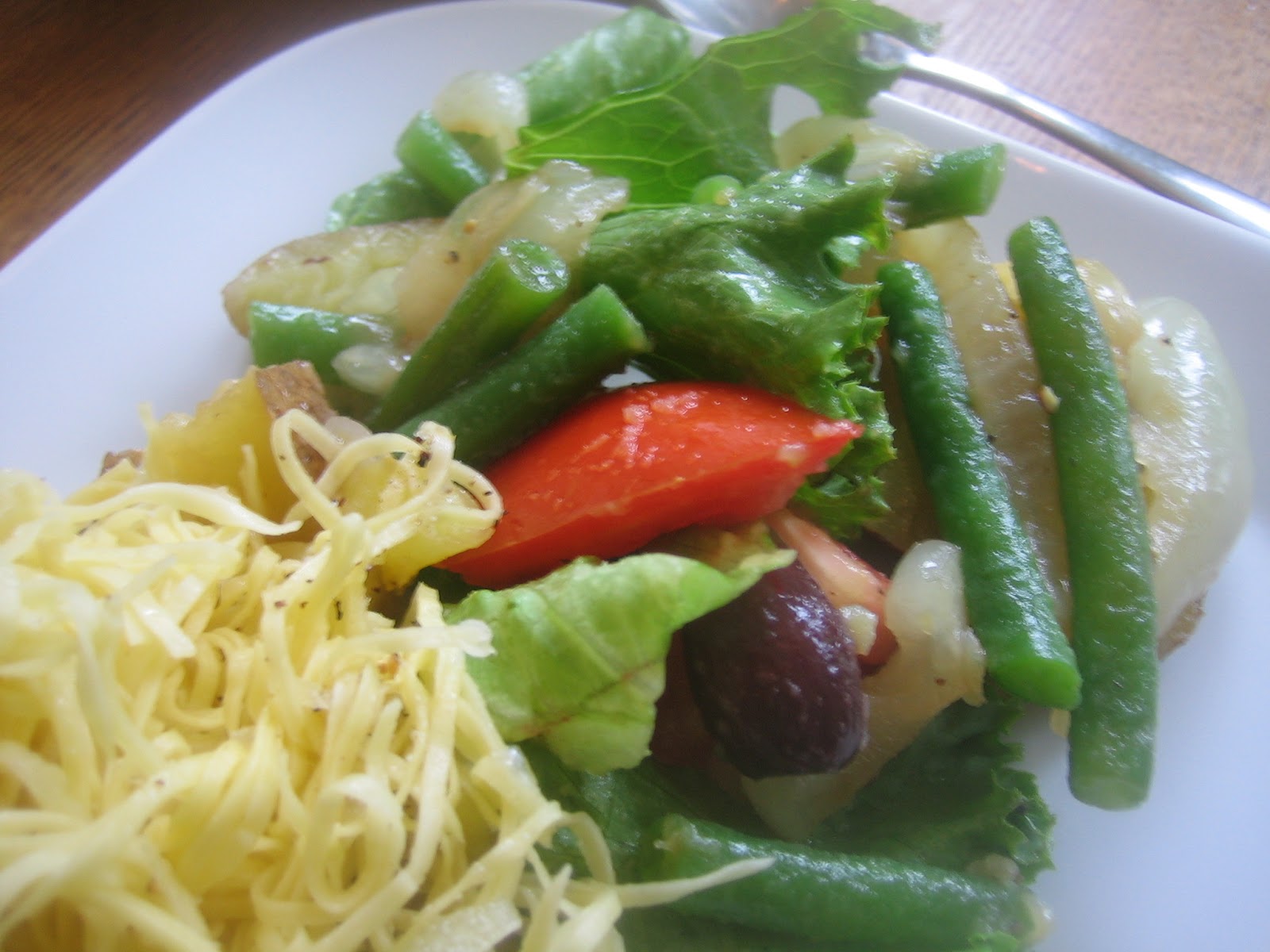
Verona is also home to some spectacular churches, and I had a terrific lunch there featuring a hefty pile of greens mixed with black olives, cannellini beans and chunks of terrific oil-cured tuna.  The kick-ass salad is definitely a relative of that Veronese salad, with the added advantage of being vegan.

This salad is all in the prep work, and could be varied according to the season.  We found one passable-looking tomato (Alaska gets notoriously terrible tomatoes), but the next time I would leave that out in favor of a vegetable in better shape.


Insalata Cruda e Cotta (Raw and Cooked Salad)

Adapted from Lidia's Italy
2 large, sweet yellow onions, peeled, trimmed and sliced 1/2" thick
1/3 cup extra-virgin olive oil
1/2 tsp. sea salt
1/2 lb. small red or gold potatoes
1/2 lb. fresh green beans, trimmed
1 fresh tomato, chopped
3/4 lb. fresh leafy salad greens
1/2 cup black olives, pitted
3 tbsp. red wine vinegar
Salt and fresh-ground black pepper to taste

Preheat the oven to 375 degrees.  Brush the onion slices with olive oil in both sides, and sprinkle with salt and pepper.  Lay them on the baking sheet and bake the onion slices approximately 25 minutes, flipping halfway through.  The onions should be a light golden brown when done.

While the onions are cooking, start a large pot of water to boil.  Clean the potatoes and drop them in the boiling water.  Cook just until the potatoes are cooked through--you want them to hold together and not get mushy.  Remove the potatoes--don't get rid of the boiling water!--and cut them in good-sized wedges when cool enough to slice.

Add the trimmed green beans to the water and boil just long enough to bring out the color, about four minutes.  You'll want the beans to stay crisp.  When you remove them from the water, put them in a bowl with cold water and ice cubes to shock them so you'll keep the gorgeous color. 

If you have a salad spinner, this is the time to put it to work.  Wash and thoroughly dry the greens--use your favorite in-season lettuces.  I had green leaf lettuce in my CSA box, so that's what I used, but it would be fun to use lettuces of different textures and colors.

In a ramekin or small bowl, combine the vinegar and remaining olive oil and whisk together.  Add salt and pepper to taste.  Then throw all of the ingredients except the lettuce and dressing in a large salad bowl and gently toss them together.  Add the lettuce and dressing and toss gently again;  serve immediately.

Makes four large salad servings.  If you do not plan to use all of the vegetable mixture, hold some back and don't toss it with the lettuce.  I had a couple lunches' worth of these salads later in the week.

Monday, April 2, 2012

Lettuce Entertain You

It's never good to start a Monday exhausted, am I right?

Eleemosynary opened on Friday night, and the actors were wonderful.  I was one kvelling director, and hooray for the great review that appeared online on Saturday.  There were four shows that opened on Friday--in Anchorage, of all places--so we're all fighting for audiences and hopefully the review will help.

On Saturday, I cooked a massive dinner for my mother-in-law Hope.  I seriously lucked out in the mother-in-law situation, although I'm not sure how hyperactive David emerged from fairly zen Hope.  I'm going to be wondering about that one for years.

So Saturday was serious cooking therapy--I'll be posting the results of the session this week.

It's really starting to look like spring in Alaska, which means melting gray snow, roads that are alternately slick and dry and moose ambling out of the woods in search of food further afield.  If you're ever thinking of coming to Alaska, this is probably not the time to do it.

This gorgeous salad is colorful, crunchy and substantial.  With the butter lettuce, it just looks like spring.  Although the original recipe called for baby heads of butter lettuce, no such luck finding those here, so I used a hydroponic full-sized head of butter lettuce.  Although my salads looked nowhere near as gorgeous as the ones in the cookbook, they were still suitable for impressing my mother-in-law.

Butter Lettuce Salad with Lemon-Shallot Vinaigrette
Adapted from the Mozza Cookbook by Nancy Silverton

1 batch lemon-shallot vinaigrette (recipe posted here)
1 head butter lettuce, leaves separated but left whole and thoroughly washed
1 cup hazelnuts, toasted
1 tbsp. hazelnut oil (good-quality olive oil would also work)
1 tsp. kosher flake salt
1/2 red onion, thinly sliced and separated into rings
1/2 small zucchini, shaved with a vegetable peeler
1/2 small yellow longneck squash, shaved with a vegetable peeler
1/2 cup finely grated Parmesan cheese

First, make the vinaigrette.  Then chop the toasted hazelnuts and toss with the oil and salt.

When you have sliced the red onion and divided it into rings, place the rings in a small bowl of ice water until you're ready to use them.

Combine the zucchini and squash shavings in a small bowl and toss with one tablespoon of the vinaigrette. 

Place one large leaf of the butter lettuce on each salad plate.  When you are ready to plate, tear the remaining lettuce into large pieces by hand and toss with the vinaigrette and half a cup of the hazelnuts in a large bowl, being careful not to overdress the salad.  Any remaining vinaigrette will keep in the fridge for at least a week.  Add a small amount of salt and pepper to the dressed salad if necessary.

Mound a small amount of the zucchini-squash mixture on the lettuce leaves on each plate, then carefully pile a small amount of the dressed lettuce on top.  Then carefully slide two rings of the red onion around the lettuce leaves, which should then hold their shape on the plate.

Repeat with the remaining plates, then sprinkle a few additional hazelnuts on each salad and dust with the Parmesan.  Makes six appetizer-size salads.

Thursday, March 15, 2012

Bad News/Good News

It's been such a mixed bag of a week.  It started with the friend who was behaving so awfully last fall suddenly deciding that he wanted to reconcile, for the oddest of reasons--still don't know what to do about that one--and then progressed to my beautiful old cat Ingrid being diagnosed with hyperthyroidism yesterday.  For those who have not had the experience of pilling a cat, it's a sight to be seen.

It's not a great photo, but just look at that face.
The good news is that the Eleemosynary cast, all three of them, put down their scripts yesterday and it turned out that they all knew their lines.  What could have been a train wreck of a rehearsal turned into my gushing at them about how wonderful they are.  We still have two weeks' worth of hard work to do before opening, but I am optimistic.

The other piece of good news is that it looks like we are headed back to Italy this year.  If you have restaurant recommendations for Rome, Verona or the regions of Alto Adige and Emilia-Romagna, please let me know.

Because I'm here to tell you:  I need a vacation, not to mention some good Italian food.

There are several things I always try to keep in my pantry, because it seems every savory dish is improved by them:  olive oil, lemons and shallots.  Those three things make a great salad dressing by themselves, but they also dress up simple side dishes, like these roasted green beans.


This healthy side dish could be varied with whatever nuts you have in your pantry, but buttery cashews add a great crunch and hit of salt.  It goes together in less than 10 minutes, and the combination of soft and crunchy is out of this world.

Roasted Green Beans with Shallots and Cashews
Adapted from Gourmet Magazine, February 2009

1 1/2 lbs. green beans, trimmed at the ends
1/2 cup salted cashews, roasted and chopped
1/3 cup shallots, chopped coarsely
1 1/2 tbsp. extra-virgin olive oil
Pinch of finely-ground black pepper

Preheat oven to 500 degrees--you will want to cook these in the lower part of the oven to prevent scorching.

In a medium bowl, combine all of the ingredients and toss to coat thoroughly.  Spread evenly on a large cookie sheet with sides.

Roast until the beans are thoroughly tender and starting to turn brown, about 20 minutes.  Stir often to make sure that the shallots aren't sticking to the pan or burning.

Serves four as a side dish.  We served with a gorgeous medium-rare steak, but the late lamented Gourmet recommended this as a side for roast chicken.

Friday, February 24, 2012

The Grail of Ingredients

Looking back at my first blog entries, I kind of want to cringe.

I didn't even sound like myself, but some weird, stilted version of myself.  I appear not to have had a sense of humor when I blogged about how I wanted to learn to cook serious Italian food and planned to use two cookbooks to guide me when doing it.  They aren't even my go-to cookbooks these days.  Sigh.

A16 Food + Wine is a great cookbook, don't get me wrong, but it assumes that you have all day to cook your dish and the bounty of San Francisco's markets at your fingertips.  

When my parents came up to visit at the end of last summer, I gave them a short list of some of the more esoteric ingredients to see if they could wrangle them at one of St. Louis' old-school Italian markets since St. Louis has a great old Italian neighborhood (for an entry about exploring that neighborhood, go here).

There was one ingredient that stumped even those markets:  bottarga.

Funny, it doesn't look like it's worth its weight in gold.
Bottarga is, according to A16, pressed mullet or tuna roe, although it now appears that it can be made of the roe from other fish.  I finally encountered it shaved over a salad at the restaurant Beast in Portland.  There's no mistaking it once you know what it tastes like:  salty and of the sea somehow.  Salmon roe has a similar taste, although it's not as intense as caviar.  You either like it or you don't.

Last Sunday morning before leaving Seattle, David and I stocked up on all things Italian at DeLaurenti's, a terrific Italian grocery at Pike Place Market (the coffee bar there, FYI, is terrific).  There, in the case with the salumi and cheese, was a hunk of bottarga.  I practically expired at the price, which was over $200 a pound or some such craziness.

We bought a tiny piece and brought it home to experiment.  This recipe from A16 is marked by its relative ease, although it assumes you have made your own oven-dried tomatoes.  I have adapted it to use storebought sun-dried tomatoes.  The bottarga is unnecessary to enjoy the dish, and vegetarians could leave it out. 

Pasta with Sun-Dried Tomatoes and Bottarga
Adapted from A16 Food + Wine

1/4 cup extra-virgin olive oil
3 cloves garlic, crushed
3 small peperoncini peppers, crushed
2 cups sun-dried tomato halves, cut in half
1/2 cup vegetarian or chicken stock
12 ounces fresh or dried pasta, preferably angel hair or bucatini
1/2 oz. bottarga

Put a large pot of salted water on to boil for the pasta.

Heat a large saucepan over medium heat, then add the olive oil.  When the oil is warm, add the garlic and peperoncini, stirring occasionally, until the garlic just starts to take color.

If using dried pasta, put it on now and cook until al dente.  Add the tomatoes to the saucepan and cook, stirring occasionally, for about ten minutes or until they have softened considerably.  About halfway through the cooking process, add the stock.

If using fresh pasta, start it now and cook for approximately a minute.  When the pasta, either fresh or dried, is cooked, reserve about a cup of the pasta water.  If the tomato mixture looks dry, add a couple of tablespoons of the pasta cooking liquid to reach the desired consistency, just thick enough to coat the pasta.

Combine the cooked pasta with the sauce and toss to coat the pasta strands.  Shave the bottarga over the pasta when it is either on a serving platter or in individual bowls.


Makes four main-course servings or six pasta course servings.

Sunday, January 1, 2012

And the Crowd Goes Wild (for Arancini)

Happy new year to everyone!

Like most people, I will be eating more salads and upping my exercise to get over the excess of the holidays.  The jeans still fit, but I know I've eaten too many bad-for-me foods over the past two weeks. 

But before I head into healthy-recipe season, I want to share the last of the fried recipes from Chrismukkah dinner.  To say these were crowd-pleasers is an understatement.  They disappeared just as quickly as I could set them out.


This recipe is ripe for experimentation, and you could make it with other varieties of risotto.  Just make sure to keep the mozzarella cubes small enough to pop in the middle of the rice balls, and after experimenting on the size I recommend keeping them about the size of ping-pong balls.

Arancini di Riso (Deep-Fried Risotto Balls)
Adapted from Lidia's Italy in America by Lidia Bastianich

5 cups low-sodium chicken stock
3 tbsp. olive oil
1 medium yellow onion, finely chopped
2 cups Arborio rice
1 cup dry white wine (I used pinot grigio)
1/2 tsp. truffle or kosher salt
1 tsp. fresh-ground black pepper
1 cup frozen peas, thawed
1 cup fresh Parmesan, finely grated
12 basil leaves, chopped
4 oz. fresh mozzarella, cut into small cubes
1 cup all-purpose flour
2 large eggs, beaten
2 cups fresh bread crumbs, toasted

Vegetable oil for frying;  enough to have an each deep in the frying pot

Heat the chicken stock over medium heat in a small pot;  keep warm on the stove.  In a medium saucepan, heat the olive oil.  Then add the onion and cook until lightly browned.

Add the rice to the onion, and toss to coat the rice.  Add the wine and bring the pot to a simmer. 

Add three cups of the chicken stock, the salt and pepper.  Bring the pot back to a simmer, stirring frequently until the stock is absorbed.  Then add the remaining stock in two installments and cook until the rice is al dente.  You will want to use all the stock.

Stir in the peas, then spread the risotto out on a baking sheet and allow it to cool to room temperature.  When it is cool, add the cheese and basil and fold to combine.


To assemble the arancini, wet your hands and take a quarter-cup of rice at a time and roll it into a ball.  Poke a cube of mozzarella into each and patch with a little more risotto to cover if necessary.

Prepare the breading station by putting the flour, eggs and bread crumbs into bowls.  Heat vegetable oil in a large deep pot;  make sure the oil doesn't exceed 350 degrees. 

Roll the arancini in the flour and shake off any excess.  Then dip the ball in egg and roll it in bread crumbs.

When all the arancini are assembled, add them a few at a time to the oil.  Fry until a deep golden color, turning them over with a wire skimmer to ensure they're browned on all sides.


Drain the arancini on cooling racks covered with paper towels.  Makes about 30 arancini.

Friday, December 30, 2011

Cuckoo for (Good) Crackers

While David and I were cooking some of the Chrismukkah food, we had the film Julie & Julia on the computer in the background.  I haven't seen this movie in a while, and definitely not since I started a blog this past July.

I've read both of Julie Powell's books;  while I liked Julie & Julia well enough , I had to skip over large portions of her follow-up book, Cleaving.  I really didn't want to hear about her affairs, particularly since I thought her husband was a little bit of a saint based on the portrayal in her first book.  Powell was somewhat more likable in the movie, but I've concluded that it was only because she was portrayed by Amy Adams, who has made a good career out of being cute and likable.

Anyway, Powell's reaction in the movie to the first comment on her blog rang true.  However, she becomes self-centered about the whole process, very "me, me, me."  Admittedly, she had a job she hated and she was basically living to blog and perhaps ultimately to get a book deal.  I'm pleased to say that the bloggers that I have met in the past five months bear no relationship to Julie Powell.  Rather, I've found the blogging community friendly and welcoming.

Getting off that tangent, I'm continuing to post recipes from the Cucina49 Chrismukkah, which peaked with a large dinner party on Christmas Day.  There were two menorahs a-blazing, competitive dreidel-spinning (our friend Nick always wins--he's got the technique down), David's brightly shining Christmas tree and, of course, lots of good food, including a decidedly non-kosher charcuterie platter.

It's easy enough to put together a good chatterer platter:  I like at least one hard and one soft cheese, preferably one cow's-milk cheese and one goat's or sheep's milk cheese.  Usually I will also have at least two types of cured meats, black olives and perhaps some mixed nuts.  Cashews and cheese are an irresistible combination.  Sliced fresh baguette or good crackers is also a must. 


Can you tell we nibbled off the raclette while we were cooking?

Note that I say good crackers, not crappy commercial crackers with lots of hydrogenated soybean oil or preservatives.  Stonewall Kitchen makes my favorite store-bought cracker, but when I have time, I prefer to make them myself.  The following recipe can be adapted to other fresh herbs and hard cheeses that may be lurking in your refrigerator.  They are buttery, flavorful and worth the relatively small amount of time and effort involved.

Rosemary-Parmesan Crackers
Adapted from Barefoot Contessa Back to Basics by Ina Garten

1/4 pound unsalted butter, at room temperature
1 cup good-quality Parmesan cheese, finely shredded
1 1/2 tsp. fresh rosemary, finely minced
1/2 tsp. kosher salt
1/2 tsp. fresh-ground black pepper
1 1/4 cups all-purpose flour

Using a stand mixer, beat the butter with the paddle attachment on medium speed until it is creamy.  Turn the mixer to low and add the rosemary, Parmesan, salt and pepper until just incorporated.


Add the flour all at once and continue beating until the flour is incorporated.  Every time I've made the recipe, the dough at this stage refuses to hold together.  Add two tablespoons of warm water and combine again--this should make the dough come together, although it will still look crumbly.

Dump the dough onto a floured cutting board and roll it into a log about one inch in diameter.  Wrap the log in plastic wrap and chill for at least one hour or overnight--this is a great item to make ahead of time. 


When you're ready to bake the crackers, heat the oven to 350 degrees.  Slice the dough into rounds about 1/4 quarter inch thick, or thinner if you prefer.

Line a cookie sheet with parchment paper and then space the rounds on that sheet--there will be about 24 crackers, depending on how thickly you've sliced them. 


Bake for about 25 minutes, rotating the cookie sheet halfway through.  The crackers will be done when they are a light golden color.


Cool on wire racks.