Food Buzz Badge

Showing posts with label healthy. Show all posts

Thursday, August 23, 2012

Cucina Povera

I've been getting to work really early lately.  Part of it is being super-busy, which I love, but part of it is that I love being in the office when it is so quiet.  This morning I can hear the rain pounding on the roof.

We're on a downhill slide into fall here in Anchorage.  I've been meaning to take pictures of the transformation, which include a flock of Canadian geese gathering on the mud flats near my house and the blooming of the fireweed.  Alaska legend is you can tell how long it will be until winter by when the fireweed finishing blooming and then goes to cotton.

For the first time in a couple of weeks, I was home to make dinner last night.  On Golden Pond is fully blocked and going well, but the nights we aren't in rehearsal I'm usually staying late at work or running the errands that I haven't had time to do. 

Last night I was determined to make something delicious, simple and packable to take to work for lunch.  I am fascinated by the Italian concept of cucina povera--literally, poverty kitchen--not because of the financial aspect of it (we are fortunate in that regard), but because it means you make a delicious dish from basically nothing. 

This dish is so simple that I kept wanting to do something more with it, like adding anchovies, chicken sausage or olives.  In the end, I left it proudly unadorned, the way it was meant to be.  It originated in Puglia, the single food region I most want to visit in Italy and haven't had the opportunity to--yet.

Rigatoni with Bread Crumbs and Parmesan
Adapted from Lidia's Italy by Lidia Bastianich

1 eight-inch piece of white country bread--baguette, French, ciabatta
1/3 cup olive oil
4 large cloves of garlic, sliced thinly
1 lb. dried rigatoni
1/4 cup Italian parsley, chopped
1/4 cup good-quality Parmesan, finely shredded, with more for garnish if desired
4 small dried peperoncino peppers, crumbled
Good-quality finishing olive oil
Sea salt and freshly-ground pepper

Trim the crust from the bread and then pull it into crumbs with your hands.  The crumbs should be various sizes.

Start a large pot of water to boil for the pasta, adding at least a tablespoon of salt.

In a large skillet, heat the olive oil.  When it is shimmering, add the bread crumbs and garlic.  Toss the crumbs to coat them with the oil, and toss occasionally when cooking so that they brown and crisp.

When the water is ready, add the pasta and cook for about nine or ten minutes, until the pasta is al dente.  Reserve half a cup of the pasta water and drain the pasta thoroughly.  Then add it back to the pot and cover it until ready to use.

The crumbs will be ready when they are lightly golden and crispy--make sure not to scorch the garlic.

Toss the pasta with a little of the cooking water to coat it.  Add the crumbs, parsley, peperoncini and Parm to the pasta and toss thoroughly.  Season with salt and pepper, then drizzle with good-quality finishing olive oil and toss again.


Serve with another grating of Parmesan.  Makes six appetizer pasta servings or four generous main course servings.  I served this with a side of fried zucchini and a bottle of dry, minerally Gruner Veltliner.

Wednesday, August 15, 2012

Goodbye Is the Hardest Part

We have all kinds of relationships in our lives...but a theatre director's relationship with a longtime stage manager?

Priceless.

For those who don't know what a stage manager does, it is the person who takes all the blocking notes, keeps the director on schedule, is the primary contact for the the designers (sound, costumes, lights, props) and, when the show opens, has the primary responsibility for making sure that it runs right and on time--and those are just the common duties.  The director hands the show over on the day it opens. 

It's a terrifying thing, or would be if I haven't been fortunate enough to have a small handful of stage managers who I also consider good friends and confidantes.

My friend Erika first stage managed for me when I directed my first professional show, Deathtrap, in 2007.  I would trust her with just about anything, and never had a second's hesitation about handing a show over to her on opening.  I've lost track of how many shows we've done together, but Sandy, the head of our local semiprofessional theatre company, calls us "the Dynamic Duo."

Eeks, it sounds like I'm eulogizing her, doesn't it?  It's not that.  Erika is heading off to a four-year program at a Russian Orthodox seminary to become a counselor.  She moves to Kodiak Island later this week.

It's a perfect fit of a profession for her, and I wish her all the best. 

David and I had Erika and Sandy over to dinner this past Sunday to say our goodbyes, or at least our "farewell for nows."  It was a lovely dinner, but of course bittersweet since we will really miss Erika.

For a first course, we served the Barefoot Contessa's salad with phyllo-wrapped goat cheese.  It's a stunning salad, even if my phyllo purses were not quite as pretty as the ones in the cookbook.  Make sure you serve the salad when the purses are fresh out of the oven.

Summer Salad with Phyllo Purses
Adapted from Barefoot Contessa Back to Basics by Ina Garten

8 sheets frozen phyllo dough, defrosted
8 tbsp. unsalted butter, melted
6 oz. log goat cheese
Baby salad greens (I used a spring mix, about 2 oz. greens per person)
2 1/2 tsp. champagne vinegar
1 tsp. coarse Dijon mustard
1 clove garlic, finely minced
1 tsp. kosher salt, plus more for serving
1/2 tsp. fresh-ground black pepper
1/2 cup extra-virgin olive oil

Preheat the oven to 375 degrees.  To prepare the phyllo purses, unroll the dough and set aside only what you need to use.  Cover the dough with a very lightly damp dishtowel--I ruined a couple of sheets of dough by using a towel that was too damp.


Trust me, they look so much better when browned.
Spread out one sheet of phyllo on a cutting board and brush all over with the melted butter.  Repeat with the remaining sheets of phyllo--you will want four sheets stacked on top of each other.  Cut the dough stack in half crosswise.

Cut the goat cheese log into discs about 1/4 inch thick.  Place two in the center of each phyllo section, then bring the sides of the phyllo square up to wrap around it.  The Barefoot Contessa compares it to wrapping a circular gift--you'll want to crimp together the top as much as you can, and get the dough as tight as possible around the bottom of each phyllo purse.

Repeat with the remaining phyllo--you will likely have some leftover goat cheese.

Spritz a small baking sheet or cake pan with nonstick spray and place the phyllo purses on it.  Bake for about twenty minutes, or until the purses are lightly browned.

In the interim, prepare the salad dressing by whisking the vinegar, mustard, garlic, salt and pepper in a small bowl.  Then whisk in the olive oil in a steady stream until the dressing emulsifies.

Place the greens in a salad bowl and toss by hand with a pinch of kosher salt, preferably flaked salt.  Then toss with the dressing until the greens are evenly coated.

Plate the salad with a small amount of dressed greens on one salad and one phyllo purse on the other.

Serves four, but could be easily doubled.

Thursday, August 9, 2012

Dazed and Confused

Some weeks I feel like I'm sprinting for Friday, full of energy and purpose.  This week I feel like I'm crawling.

It hasn't been a bad week, just an exhausting one.  Work has been super-busy (not that I'm complaining--better that way than the reverse), and we just blitzed through blocking twenty-four pages of On Golden Pond over the last two nights.

Somehow, David and I have no plans for the next couple of nights.  I'm kind of grateful.  I foresee a long walk in my future tonight, followed by a glass of wine and some of the good cheese here my parents schlepped from one of the Italian markets in St. Louis.

A totally random photo demonstrating what happens if one flops on the
bed in our household.  Ingrid considers you her personal chaise.
David is doing somewhat better after his rib-fracturing bike accident a couple of weeks ago, but he's not up to hiking or other outdoor activity yet, so I also foresee a solo hike in my future this weekend.

We also received the latest CSA box, which includes a bunch of one of my favorite veggies, Swiss chard.  I love the stuff but am forever trying to find new ways to prepare it.

This recipe might win over people who don't particularly like dark leafy greens--it is savory and just slightly cheesy, and it has a terrific combination of tender and crispy bits.  While the original recipe did not call for oiling the pan prior before placing the chard cakes in it, they wanted to stick without it.  I thought it sounded weird not to oil the pan, but who am I to overrule Lidia?  Learn from my mistake.

Crispy Swiss Chard Cakes
Adapted from Lidia's Italy by Lidia Bastianich

1 lb. rainbow chard
2 tbsp. good olive oil
1/2 medium yellow onion, thinly sliced
3/4 tsp. sea salt
1 1/2 tbsp. unsalted butter
1/4 tsp. fresh-ground black pepper
1 cup Parmesan cheese, finely shredded
1 egg yolk, beaten

Wash the chard and trim off the stems, then trim away the central ribs.  You won't be using these for the dish, but they are great slow-cooked with a little broth, oil and garlic.

Bring a large pot of water to boil over high heat, then add the chard leaves.  Continue to let the pot boil for about twenty minutes, or until the chard is tender.  Drain and rinse the chard under cool water, and then finely chop the chard.

Here's the step I can't emphasize enough--squeeze every drop of water you can out of the chard, or the cakes will fall apart. 

Heat a large skillet over medium heat and add the butter.  When it is melted, add the onion and half a teaspoon of salt.  Cook the onion until it turns lightly brown, then add the chard and remaining salt.  Cook another 7-8 minutes, until the butter has all been absorbed.  You will want the chard to be dry but not crispy.

Remove the chard from the skillet and let the skillet cool.  When it is cool enough to handle, wipe it absolutely clean. 

When the chard is lukewarm to the touch, combine it with the cheese and egg yolk.  Divide the mixture into small patties and press them together firmly.  If there seems to be too much liquid in the mixture, squeeze some out and start again.

Reheat the skillet over medium heat and add the olive oil.  When the oil is shimmering, carefully place the chard cakes in the skillet.  Cook for about three minutes per side, then drain on a paper towel.


Serve warm--should make about four large cakes or six small ones.  We served them with a grilled Florentine steak, though they would make a fantastic addition to a vegetarian meal.

Tuesday, July 31, 2012

Shorthand It

I hate when I've gone a week between posts--which I never mean to do, but life happens--because it means that there is too much to catch up on.  It makes me think of a scene from Will and Grace, a show I used to love.  Will and Grace had a fight, they want all the drama to be over, but don't want to go through a big, emotional, apologetic conversation.  Grace says, "Let's shorthand it."  They both laugh for a second, fake-cry for a second, hug and the fight is over. 

If only.

So let me shorthand it--here are the bullet points:
  • On Golden Pond is finally cast, and I'm really pleased with everyone involved. 
  • David managed to fracture and displace one of his ribs in a mountain biking accident last weekend, plus sprain his right wrist.  He'll be fine, but he's a little helpless right now.
  • My parents are in town for their annual visit.
  • I had one of the longest depositions of my career last Friday, in which opposing counsel beat up on my psychiatric expert and was just a total jerk.
You would think that the last one wouldn't surprise me at this point, but I work in such a specialized field that I see about the same thirty lawyers over and over again.  The vast majority of them manage to be totally civil while disagreeing with each other.  I think the motivation to be nice is that we're all going to see each other again, so don't want to piss each other off.  This guy was not one of the thirty people I usually see, and obviously was not advised about the civility rule.

I have two more depositions with him in August.  Give me strength.

Last week I posted the crisp green salad with quinoa that I served with Nigella's salmon.  Salmon fishing is at its peak in Alaska right now--friends keep bringing home upwards of twenty fish and we're often the lucky recipients of extra fish.  This recipe is dead simple--portion the fish, pat it dry, dunk in seasoning and then pan fry.  Couldn't be easier.

Seared Mustard-Crusted Salmon
Adapted from Forever Summer by Nigella Lawson

2 tbsp. olive oil
1 tsp. granulated sugar
1 1/2 tbsp. crushed mustard seed or powder
4 6 oz. fillets of salmon (the recipe calls for skinless, but I left the skin on)

Preheat a large skillet over medium heat.  When the skillet is warm, add the oil. 

In a shallow bowl, mix together the sugar and mustard.  Dredge the fish in it--if you are using skinless fillets, dredge it on both sides.

Throw a plate in the oven to warm.  Then add the fillets to the skillet and cook for three minutes on each side.  If you are using fillets with skin, start with the skin facing up.  You might want to check one of the fillets at the six-minute mark to make sure it is cooked through, although this recipe is meant to keep the salmon juicy and slightly opaque. 

Remove to the warmed plate and serve with last week's greens and quinoa.  Makes a lovely summer dinner for four.

Tuesday, July 24, 2012

Here Comes the Sun

The sun is out!

This wouldn't be such an occasion for celebration were it not for the fact that it has been gray and rainy since last Friday night.  My hiking shoes and I will be heading out after work.

Despite the gloomy weather, I haven't been cooking much over the past couple of weeks.  Part of it is the casting process for On Golden Pond, which sadly remains ongoing as I seek out the last person, plus long hours at work, but part of it is that I've been wanting to eat basically two things:  Mexican food and salad.

There have been lots of blogs lately extolling the virtues of quinoa, a chewy little grain that takes on the flavors with which it's surrounded.  I have nothing but love for it, especially since it's kosher for Passover (a huge discovery this year) and a complete protein.  It's good hot or cold, and pairs particularly well with summery fish dishes.

This salad would make a light main course or a perfect side--I served it with Nigella's mustard-coated salmon.  I've doctored it up to add some additional color and crunch from radishes.  The ones we get in Alaska are vividly colored and very peppery, and I can't resist them.  We ate this salad outside on a sunny night with a bottle of Italian white wine.

Quinoa Salad with Greens and Spring Onions
Adapted from Salad as a Meal by Patricia Wells

For the salad:
1 1/2 cups quinoa
3 cups vegetable or chicken stock
2 dried bay leaves
1 tsp. coarse sea salt
1 tbsp. lemon juice
2 cups parsley leaves, coarsely chopped
1 tbsp. good olive oil
3 small spring onions (or scallions, if spring onions aren't available)
5 oz. baby spinach
4 radishes, sliced thinly

For the dressing:
2 tbsp. lemon juice
1/2 tsp. coarse sea salt
1 cup 2% milk
1/3 cup chives, minced
Lemon zest

Toast the quinoa in a large saucepan over medium heat, shaking or stirring it regularly until it crackles, about five minutes.  Remove the quinoa from heat and rinse it in a sieve with cold water.

Return the saucepan to the stove and heat the stock to a boil.  Add the quinoa, bay leaves and salt, then reduce the heat.  Cover the saucepan and simmer for about 15 minutes, stirring occasionally.  Taste the quinoa to see how chewy it is and cook for an additional five minutes if it isn't soft enough.

Remove the quinoa from the stove and allow to sit for an additional ten minutes.  While it is cooling, whir the lemon juice, parsley and olive oil in a mini-prep food processor until the parsley is very fine.  Pour this mixture into a small bowl and add the spring onions and radishes to marinate them.

Then make the dressing:  in a jelly jar with a lid, combine the lemon juice and salt and shake to combine.  Let sit for a minute to dissolve the salt, then drizzle in the milk.  Shake to combine, then add the chives and lemon zest.  This will make more than enough dressing for this dish--you could halve the recipe if you don't want leftovers.

Doesn't this look like the best brown-bag lunch?

When ready to serve, toss the baby spinach with enough dressing to coat the leaves but not leave a lot of extra.  Then combine the quinoa with the marinated vegetables.  The original recipe calls for these two mixtures to be combined, but I left them separate--all the better to keep the spinach fresh for leftovers. 

Makes four main course servings, and would easily serve six as a side.

Monday, July 2, 2012

Climb Ev'ry Mountain (At Least the Easy Ones)

I love Anchorage in the summer, last post's weather gripes aside.

We had fabulous friends over for dinner on Friday (there was an ill-fated clafoutis incident that I won't bother you with here), dinner with a friend of my parents on Saturday, and then walked past a street fair to meet some other friends later that night.  On nice days in Anchorage, you run into everyone downtown--forget six degrees of separation, it's more like two.

Yesterday David and I went hiking at Falls Creek Trail, which is a very steep uphill trail through trees to a valley at the end.  The state's website says the difficulty is "moderate," which may be true if you're a mountain goat or a Dall sheep.  My pedometer said that the uphill was the equivalent of going up 141 flights of stairs, if that can be believed, and my legs are a little on the sore side today.

A view of Turnagain Arm from
further up the trail.

By the time we rolled off the mountain dirty and sweaty, I didn't want to do anything too complicated for dinner.  Halibut tacos are one of the great Alaskan summer dishes--you can find them on menus around the state while the halibut is fresh, and while some restaurants are stupid enough to deep-fry halibut chunks for the tacos, this broiled version is much tastier and healthier.

I sauteed a small red spring onion and half a jalapeno and mixed them with a can of black beans for a side.  Green tomatillo salsa is a perfect complement to the tacos.

Halibut Tacos
Adapted from A Platter of Figs by David Tanis

1 lb. halibut steak or fillet
2 small peperoncino peppers, crushed
2 cloves garlic, minced
1 tsp. dried oregano
Extra-virgin olive oil
1/2 head green cabbage, thinly shredded
1 lime, juiced
Small corn or flour tortillas
Kosher salt and fresh-ground black pepper

For serving:
Guacamole
Black beans
Lowfat plain yogurt or sour cream
Salsa

Pat the fish dry and sprinkle with salt and pepper on both sides.  Preheat the broiler or, if it's a nice day, prepare your grill and cook the fish outside.

Combine the garlic, peppers and dried oregano in a ramekin, then spread on one side of the fish.  Drizzle the fish with olive oil on the same side.  If you have time to marinate the fish for an hour or so, cover it and put it in the fridge.  You'll want to let it come back up to room temperature before cooking.

In a small bowl, toss the shredded cabbage with a little salt, then add the lime juice and toss again.  Set it aside while you're cooking the fish.

Place the fish on a baking sheet and broil on high for about three minutes on each side.  The fish will be done when it flakes into large chunks and is opaque inside. 


Serve with warmed tortillas and garnish with the shredded cabbage and other fixings.

Serves 2 with leftovers.

Thursday, June 28, 2012

Summertime Blues

I am so ready for the alternately gray, rainy and humid and brightly sunny weather in Anchorage to stop--it's as if the weather is bipolar.  Every morning I get up, poke my head out the window and decide whether to wear tights to work or if my legs will freeze if I go bare-legged.

Regardless of the weather, though, I am really in the mood for classic summer foods.  Ripe fruit, fresh corn and a good grilled steak all sound perfect right now.

Today I have the great good fortune to be guest blogging for the very first time for the lovely Kristen at Frugal Antics of a Harried Homemaker.  Her blog has been one of my favorites since I started blogging almost a year ago--she cooks creative, often gluten-free recipes that are economical and doable for the home cook.

In keeping with her philosophy, I give you this version of a summer succotash that can be adapted to whatever vegetables look good where you live.  It's vegetarian, healthy, simple to put together and full of flavor.  Serve alongside roasted meats or keep it vegetarian with a side of couscous or rice.  Either way, it's delicious--and I should know, since I've been eating the leftovers for lunch the last couple of days.  It's one of those dishes that gets even better the next day.

Check out this Farmstand Summer Salad with Jalapeno Butter here.

As a total aside, the terrific writer and director Nora Ephron, who directed Julie & Julia and You've Got Mail, and who wrote one of the all-time great screenplays, When Harry Met Sally, died Tuesday.  You may not know she started as a journalist and was once a food writer, which probably explains why there so many scenes of eating in her films.  The New York Times published a terrific article about her yesterday that talked about her love of food, which you can find here.

Now head on over to Kristen's blog and check out the salad!


Tuesday, April 24, 2012

A Pox on Your House, Thomas Keller

There was a line in the show I just directed:  "Some words are meant to be spelled, not used." 

My adaptation of that line: some recipes are meant to be aspirational, not made.

I read food magazines on the elliptical at the gym, which is a way to pass the time and dream about food that I don't always want to make.  So when I read the article about chef recipes made easy, I was intrigued.  Despite the fact that one of them was by Thomas Keller.

I know I've said this before, but I pretty much never use my Thomas Keller cookbooks.  They're fun to look at, but I have no desire to spend six hours and every pot in my kitchen making dinner.  But what can I say?  The recipe sounded great.


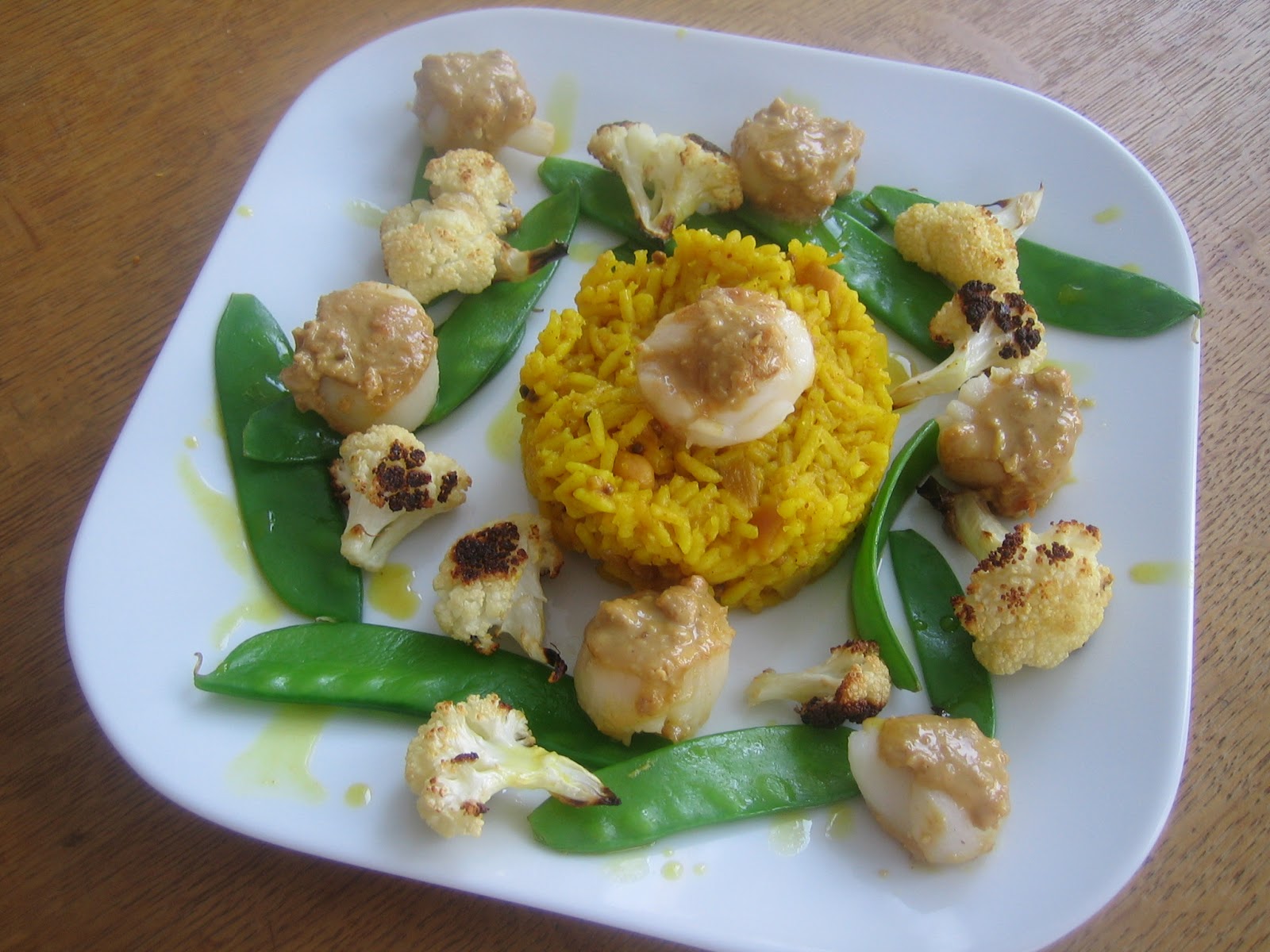
Two hours later and only most of the pots in my kitchen sullied (what did I DO with all that time?), I concluded that even a simplified Thomas Keller recipe was more than I wanted to do for a weeknight dinner.  But hey, it sure looked pretty, and it was quite tasty except for the fact that the recipe had the vegetables finishing way before you're ready to use them.  I've modified the recipe here to hopefully get everything to the table still warm. 

I was unable to find large sea scallops on the day I made this, but I recommend them if they are available.  That gorgeous, spicy rice recipe will come later this week.

Seared Scallops with Peanut Sauce
Adapted from Food & Wine Magazine, January 2012

2 tsp. hot curry powder
1/4 cup extra-virgin olive oil
2 tbsp. fresh-squeezed lime juice
1/2 lb. cauliflower, cut into small pieces
6 oz. snow peas, trimmed
2 tbsp. panko crumbs
1/4 cup plus 2 tbsp. crunchy peanut butter, preferably natural
1 1/2 pounds sea scallops, preferably large
Kosher salt and fresh-ground pepper to taste

Preheat the oven to 450 degrees.  In a small jar or bowl, shake or whisk together the curry powder and olive oil.  Let this sit for at least 15 minutes, or until the curry settles at the bottom.  Then strain through a coffee filter so the curry is removed, leaving you with just the oil.  Stir in the lime juice and add salt and pepper to taste.

Arrange the cauliflower on a baking sheet and drizzle evenly with two tablespoons of the olive oil.  Meanwhile, bring a small pot of water to a boil for the peas.

In a small skillet, warm one tablespoon of the olive oil.  When it is shimmering, add the panko crumbs and stir until they are slightly toasted, about three minutes.

Pat the scallops dry and season them with salt and pepper.  Place the cauliflower in the oven and bake until it is brown in spots, about fifteen minutes.  Place a large, oven-safe saucepan over high heat and add the remaining olive oil.

While the oil is heating, combine the panko crumbs with the peanut butter and stir to combine. 

When the oil is shimmering, add the scallops and sear them on one side for approximately four minutes.  Then turn the scallops over and lightly sear for another minute;  then remove the pan from the heat and top each scallop with a dollop of the peanut sauce.

Place the saucepan in the oven for approximately two minutes, which should melt the peanut sauce.  Boil the snow peas for approximately one minute, then immediately drain and rinse in cold water.

Remove the scallops and cauliflower from the oven and plate immediately on a bed of the cauliflower and snow peas.  Once the scallops, cauliflower and snow peas are on the plate, drizzle with a little of the curry oil.  Serve immediately.

Serves 4 as a light main dish.


Thursday, March 15, 2012

Bad News/Good News

It's been such a mixed bag of a week.  It started with the friend who was behaving so awfully last fall suddenly deciding that he wanted to reconcile, for the oddest of reasons--still don't know what to do about that one--and then progressed to my beautiful old cat Ingrid being diagnosed with hyperthyroidism yesterday.  For those who have not had the experience of pilling a cat, it's a sight to be seen.

It's not a great photo, but just look at that face.
The good news is that the Eleemosynary cast, all three of them, put down their scripts yesterday and it turned out that they all knew their lines.  What could have been a train wreck of a rehearsal turned into my gushing at them about how wonderful they are.  We still have two weeks' worth of hard work to do before opening, but I am optimistic.

The other piece of good news is that it looks like we are headed back to Italy this year.  If you have restaurant recommendations for Rome, Verona or the regions of Alto Adige and Emilia-Romagna, please let me know.

Because I'm here to tell you:  I need a vacation, not to mention some good Italian food.

There are several things I always try to keep in my pantry, because it seems every savory dish is improved by them:  olive oil, lemons and shallots.  Those three things make a great salad dressing by themselves, but they also dress up simple side dishes, like these roasted green beans.


This healthy side dish could be varied with whatever nuts you have in your pantry, but buttery cashews add a great crunch and hit of salt.  It goes together in less than 10 minutes, and the combination of soft and crunchy is out of this world.

Roasted Green Beans with Shallots and Cashews
Adapted from Gourmet Magazine, February 2009

1 1/2 lbs. green beans, trimmed at the ends
1/2 cup salted cashews, roasted and chopped
1/3 cup shallots, chopped coarsely
1 1/2 tbsp. extra-virgin olive oil
Pinch of finely-ground black pepper

Preheat oven to 500 degrees--you will want to cook these in the lower part of the oven to prevent scorching.

In a medium bowl, combine all of the ingredients and toss to coat thoroughly.  Spread evenly on a large cookie sheet with sides.

Roast until the beans are thoroughly tender and starting to turn brown, about 20 minutes.  Stir often to make sure that the shallots aren't sticking to the pan or burning.

Serves four as a side dish.  We served with a gorgeous medium-rare steak, but the late lamented Gourmet recommended this as a side for roast chicken.

Friday, February 24, 2012

The Grail of Ingredients

Looking back at my first blog entries, I kind of want to cringe.

I didn't even sound like myself, but some weird, stilted version of myself.  I appear not to have had a sense of humor when I blogged about how I wanted to learn to cook serious Italian food and planned to use two cookbooks to guide me when doing it.  They aren't even my go-to cookbooks these days.  Sigh.

A16 Food + Wine is a great cookbook, don't get me wrong, but it assumes that you have all day to cook your dish and the bounty of San Francisco's markets at your fingertips.  

When my parents came up to visit at the end of last summer, I gave them a short list of some of the more esoteric ingredients to see if they could wrangle them at one of St. Louis' old-school Italian markets since St. Louis has a great old Italian neighborhood (for an entry about exploring that neighborhood, go here).

There was one ingredient that stumped even those markets:  bottarga.

Funny, it doesn't look like it's worth its weight in gold.
Bottarga is, according to A16, pressed mullet or tuna roe, although it now appears that it can be made of the roe from other fish.  I finally encountered it shaved over a salad at the restaurant Beast in Portland.  There's no mistaking it once you know what it tastes like:  salty and of the sea somehow.  Salmon roe has a similar taste, although it's not as intense as caviar.  You either like it or you don't.

Last Sunday morning before leaving Seattle, David and I stocked up on all things Italian at DeLaurenti's, a terrific Italian grocery at Pike Place Market (the coffee bar there, FYI, is terrific).  There, in the case with the salumi and cheese, was a hunk of bottarga.  I practically expired at the price, which was over $200 a pound or some such craziness.

We bought a tiny piece and brought it home to experiment.  This recipe from A16 is marked by its relative ease, although it assumes you have made your own oven-dried tomatoes.  I have adapted it to use storebought sun-dried tomatoes.  The bottarga is unnecessary to enjoy the dish, and vegetarians could leave it out. 

Pasta with Sun-Dried Tomatoes and Bottarga
Adapted from A16 Food + Wine

1/4 cup extra-virgin olive oil
3 cloves garlic, crushed
3 small peperoncini peppers, crushed
2 cups sun-dried tomato halves, cut in half
1/2 cup vegetarian or chicken stock
12 ounces fresh or dried pasta, preferably angel hair or bucatini
1/2 oz. bottarga

Put a large pot of salted water on to boil for the pasta.

Heat a large saucepan over medium heat, then add the olive oil.  When the oil is warm, add the garlic and peperoncini, stirring occasionally, until the garlic just starts to take color.

If using dried pasta, put it on now and cook until al dente.  Add the tomatoes to the saucepan and cook, stirring occasionally, for about ten minutes or until they have softened considerably.  About halfway through the cooking process, add the stock.

If using fresh pasta, start it now and cook for approximately a minute.  When the pasta, either fresh or dried, is cooked, reserve about a cup of the pasta water.  If the tomato mixture looks dry, add a couple of tablespoons of the pasta cooking liquid to reach the desired consistency, just thick enough to coat the pasta.

Combine the cooked pasta with the sauce and toss to coat the pasta strands.  Shave the bottarga over the pasta when it is either on a serving platter or in individual bowls.


Makes four main-course servings or six pasta course servings.

Wednesday, February 22, 2012

Vintage Gourmet: Prawn Curry

As a movie buff, I am following the whole discussion about The Help with great interest.  This isn't a new discussion, of course, but it seems to have risen as a topic of conversation again because the movie is up for a number of Oscars this weekend, and Viola Davis and/or Octavia Spencer may actually win.

The issue is partially who has the authenticity and the right to tell the story of African-American maids in the 1960s South, and also whether it is demeaning for prominent actresses to have to play maids at this point in their careers.

I'm not participating in this debate, other than to say I'm always happy to see Viola Davis in any role and she gave a great interview on NPR where she talked about drawing on her mother's experiences as a maid.  The movie itself was kind of a meh for me despite some good acting.
The interesting question to my mind is this:  what is authentic? 

I swear that long segue has something to do with cooking.  Last week, I decided to make a prawn curry, mostly because I'd had a not-great chicken curry at an Asian-fusion restaurant the week before that was totally ruined by the addition of a liberal handful of pineapple tidbits.

Surely, I thought, I could make something more authentic than that.  But really, I'm not sure that I did, particularly after reading the terrific curry recipes written by some of my fellow bloggers.

I will say this:  it tasted awfully good, authentic or not.  A warning on the heat quotient:  I left the seeds in the bird peppers, but omitted them from the habanero.  It was what I'd called medium spicy, not for the faint of heart but not requiring either David or I to fan our mouths in pain.

Prawn Curry
Adapted from Gourmet Magazine, August 2008

1 small red bird pepper, minced
1 small yellow bird pepper, minced
1 small orange habanero pepper, seeds omitted, minced
1 tsp. good-quality hot curry powder (I used Penzey's)
1 tbsp. fresh ginger, peeled and minced
4 garlic cloves, chopped
1 1/2 tbsp. vegetable oil
1 tsp. whole mustard seeds
1 tsp. whole coriander seeds
1/2 tsp. ground cumin
1/4 tsp. ground turmeric
1 medium onion, sliced
1 can light coconut milk
1 1/2 pounds large prawns, peeled

Warm a large skillet over medium heat, then add the oil.  When the oil is shimmering, add the chiles, curry powder, garlic and ginger.  Cook, stirring frequently until the chiles are softened.

Add the mustard and coriander seeds, cumin and turmeric and cook, stirring frequently, until the seeds start to pop.

Add the onion and cook for about another five minutes, stirring occasionally, until it starts to go limp.  Then add the coconut milk and stir to combine the ingredients.  Cook until the milk is reduced slightly, about five minutes.

Add the shrimp and cook until they are bright pink and cooked through, about five to seven minutes.  Taste for seasoning and serve hot with jasmine or basmati rice.  I added a few drops of sesame oil to the rice for a little additional depth of flavor.


Serves four as a main course.

Thursday, February 9, 2012

Nesting Instinct

I love living in Anchorage.  Very little gets cancelled when there are several feet of snow, but "slippery conditions" that seem to be very similar to yesterday's slippery conditions have shut down a large portion of the city schools.  Maybe I'm just being grumpy because I'd like to stay home today, too.

 
I really should take the computer cables
out of the background before taking
photos, shouldn't I?
It's been great to be home most evenings this week now that Love, Loss has closed.  I start rehearsals for my next directing project in a couple of weeks, but in the interim I am doing what I like to call "nesting."  As in, cleaning the house, catching up on the bad television I didn't see while I was performing (thanks, Hulu!), reading and cooking.

This recipe is an adaptation of one for sashimi that I received from Iron Horse, the Sonoma winery.  The recipes are often lovely but a little complicated.  I'm sure someone has Madras curry oil in their pantry, but it sure isn't the majority of their consumers.  With a little punting, though, this became a fantastic light main dish.  I just wish I'd had a colorful sauce to use as well.  Next time!

Seared Yellowfin Tuna with Curry Oil and Soy Glaze
Adapted from a Recipe by Chef Ming Tsai

1 lb. yellowfin tuna fillets, pounded to 1/4 inch thickness
1/4 cup extra-virgin olive oil
1 tsp. curry powder or curry powder blend (I used Penzey's Singapore Seasoning Blend)
Sea salt and pepper
1 shallot, minced
1 cup low-sodium soy sauce
Juice of 1/2 lime
1 tbsp. brown sugar

Once you have pounded the tuna, cut into four servings.  Sprinkle with sea salt and pepper and return to the refrigerator.

In a small pot, combine the lime juice, soy sauce and brown sugar and bring to a boil over medium-high heat.  Then reduce heat to medium and cook for about a half hour, stirring occasionally, until the mixture has reduced to about a fourth of its original volume.  Once it is finished, set it aside to cool and then pour it into a squeeze bottle.

In a ramekin or measuring cup, combine the olive oil and curry powder.  Stir and set aside until needed.

After the soy mixture has been cooking for about twenty minutes, warm a large saucepan over medium heat and remove the tuna from the refrigerator.  Add the curry oil to the saucepan, stirring to ensure even distribution of the spices, which will want to separate from the oil.  When the oil is warm, add the shallot and saute for about two to three minutes, until it is softened.  Remove the shallot from the pan and set aside.

Turn the heat up to medium-high and add the tuna steaks.  Sear them briefly, about a minute on each side, which will leave them just pink in the center.


Drizzle the plates with the soy glaze.  If desired,  dot any remaining curry oil on the plates too.  Plate the fish with a small portion of the shallots on top and serve with rice and a side of steamed or stir-fried vegetables.

Serves four as a light main dish.

Tuesday, January 31, 2012

Vintage Gourmet: Sweet and Hot

A few weeks ago, I bemoaned the loss of Gourmet Magazine, which shut down in November 2009 and ended my monthly dose of Ruth Reichl.  I love Reichl's writing, particularly her food writing, and it's been too long since her last book.

So when I was griping at dinner about how much I missed Gourmet, David said the fateful words "Why don't you see if there are some issues on ebay?" 

I love ebay.  In fact, I love ebay so much that I bought my wedding dress there three years ago and had a local costume designer take it apart and alter it.  It cost a lot less than any conventional wedding dress and was way prettier.

So as a result of David uttering those fateful words, Gourmet magazine is making a comeback at our house.  It's such a joy to look at them--the photography is great, the now-dated ads are fun and the articles are so well-written.  Not that I'm suggesting you go stalk these magazines on ebay, mind you.  No sirree, because I have a few more I'm looking for and I don't want you to snap them up.

So how about you let me report back via a new feature that I'm calling "Vintage Gourmet"?  The idea is to pull recipes from random back issues of Gourmet, put my own spin on them and post them here.  Welcome to the first installment!

This recipe is a keeper:  inexpensive, equally worthy of a weeknight dinner or a dinner party and less than 45 minutes to make. 


Chicken with Sweet and Hot Peppers
Adapted from Gourmet Magazine, March 2003

2 lbs. bone-in, skin-on chicken thighs
2 tbsp. olive oil
2 bell peppers, preferably red and yellow, thinly sliced
1/2 onion, thinly sliced
2 cloves garlic, smashed with the flat of a knife and peeled
1/2 shallot, minced
1/4 cup dry white wine
3 dried peperoncini peppers, crushed
Kosher salt and fresh-ground black pepper

Place the chicken thighs on a paper towel-lined plate and dry thoroughly.  Sprinkle salt on the skin side and put aside.

Warm the olive oil in a large, oven-safe skillet over medium heat.  When the oil is shimmering, add the chicken thighs skin side down.  Cook for approximately five minutes or until the chicken skin is a lovely golden brown.  Then turn the chicken over with tongs and cook for an additional two minutes.  The chicken will not be cooked through at this time;  this is just to crisp the skin.


Pour all but about a tablespoon of the fat from the skillet and return it to the stove.  Still over medium heat, add the peppers, onion and shallot and cover and cook until the veggies are softened, about ten minutes.  Then add the white wine, peperoncini, garlic and salt and pepper to taste and cook until the wine has reduced, about two minutes.
Nestle the chicken skin side up in the pepper mixture, reduce heat to medium and cook, covered, for another fifteen to twenty minutes. 

Start the broiler on high.  Uncover the chicken and place the skillet under the broiler just until the skin is very brown and crispy.
We served with a root vegetable mash and baked leeks.  Once again, remove the chicken skin if you are watching fat, cholesterol and/or calories.