Food Buzz Badge

Showing posts with label Vegetables. Show all posts

Tuesday, June 12, 2012

Wherefore Art Thou, Dinner?

At the rate I'm going, it will be fall before I work through all of the posts related to my vacation.  Plus I promised the kick-ass salad recipe last week.  I seriously don't know where all the time goes.

David and I went to several regions in Italy, but the one we spent the least amount of time in was the Veneto.  This region, in northeastern Italy, is famous mostly for containing Venice, which we skipped this time around because we didn't have enough time to do it justice.  (As an aside, if you ever want to see a truly, atmospherically spooky movie, Netflix Don't Look Now, which stars Donald Sutherland and Julie Christie as a couple vacationing in Venice after losing their young daughter in an accident.  I seriously shrieked out loud at the end.)

Artwork made from recent letters written to Juliet.

The sole place we visited in the Veneto was Verona--the English major in me couldn't resist the opportunity to visit the place where two of Shakespeare's plays were set.  But sorry, Two Gentlemen of Verona, this city is all about Romeo and Juliet.  You can visit Juliet's balcony, Juliet's house and Juliet's tomb--and while the Capulet/Montague feud may have been based on history, you can bet that there was not really a Juliet.  Nevertheless, that doesn't stop throngs of tourists from visiting these attractions, particularly the balcony.

In the courtyard under the balcony, there is a statue of Juliet.  Legend has it that it is good luck to rub her right breast, and we saw lots of people doing it.  We skipped that little attraction and went into the house, which gives you an opportunity to go out on the tiny balcony.  Here's David standing on it, but sadly I couldn't get him to recite the balcony speech to the throngs below.

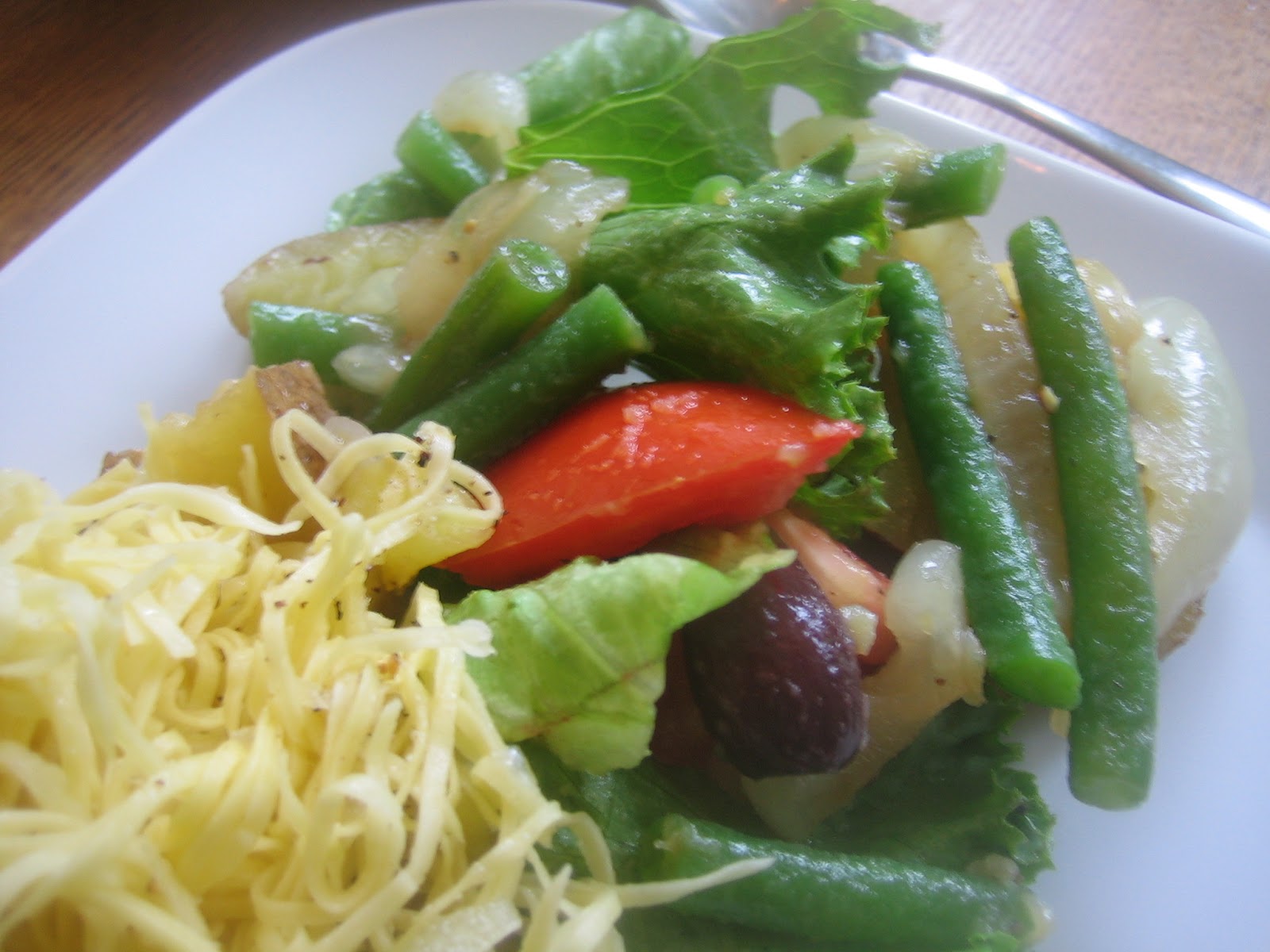
Verona is also home to some spectacular churches, and I had a terrific lunch there featuring a hefty pile of greens mixed with black olives, cannellini beans and chunks of terrific oil-cured tuna.  The kick-ass salad is definitely a relative of that Veronese salad, with the added advantage of being vegan.

This salad is all in the prep work, and could be varied according to the season.  We found one passable-looking tomato (Alaska gets notoriously terrible tomatoes), but the next time I would leave that out in favor of a vegetable in better shape.


Insalata Cruda e Cotta (Raw and Cooked Salad)

Adapted from Lidia's Italy
2 large, sweet yellow onions, peeled, trimmed and sliced 1/2" thick
1/3 cup extra-virgin olive oil
1/2 tsp. sea salt
1/2 lb. small red or gold potatoes
1/2 lb. fresh green beans, trimmed
1 fresh tomato, chopped
3/4 lb. fresh leafy salad greens
1/2 cup black olives, pitted
3 tbsp. red wine vinegar
Salt and fresh-ground black pepper to taste

Preheat the oven to 375 degrees.  Brush the onion slices with olive oil in both sides, and sprinkle with salt and pepper.  Lay them on the baking sheet and bake the onion slices approximately 25 minutes, flipping halfway through.  The onions should be a light golden brown when done.

While the onions are cooking, start a large pot of water to boil.  Clean the potatoes and drop them in the boiling water.  Cook just until the potatoes are cooked through--you want them to hold together and not get mushy.  Remove the potatoes--don't get rid of the boiling water!--and cut them in good-sized wedges when cool enough to slice.

Add the trimmed green beans to the water and boil just long enough to bring out the color, about four minutes.  You'll want the beans to stay crisp.  When you remove them from the water, put them in a bowl with cold water and ice cubes to shock them so you'll keep the gorgeous color. 

If you have a salad spinner, this is the time to put it to work.  Wash and thoroughly dry the greens--use your favorite in-season lettuces.  I had green leaf lettuce in my CSA box, so that's what I used, but it would be fun to use lettuces of different textures and colors.

In a ramekin or small bowl, combine the vinegar and remaining olive oil and whisk together.  Add salt and pepper to taste.  Then throw all of the ingredients except the lettuce and dressing in a large salad bowl and gently toss them together.  Add the lettuce and dressing and toss gently again;  serve immediately.

Makes four large salad servings.  If you do not plan to use all of the vegetable mixture, hold some back and don't toss it with the lettuce.  I had a couple lunches' worth of these salads later in the week.

Thursday, March 15, 2012

Bad News/Good News

It's been such a mixed bag of a week.  It started with the friend who was behaving so awfully last fall suddenly deciding that he wanted to reconcile, for the oddest of reasons--still don't know what to do about that one--and then progressed to my beautiful old cat Ingrid being diagnosed with hyperthyroidism yesterday.  For those who have not had the experience of pilling a cat, it's a sight to be seen.

It's not a great photo, but just look at that face.
The good news is that the Eleemosynary cast, all three of them, put down their scripts yesterday and it turned out that they all knew their lines.  What could have been a train wreck of a rehearsal turned into my gushing at them about how wonderful they are.  We still have two weeks' worth of hard work to do before opening, but I am optimistic.

The other piece of good news is that it looks like we are headed back to Italy this year.  If you have restaurant recommendations for Rome, Verona or the regions of Alto Adige and Emilia-Romagna, please let me know.

Because I'm here to tell you:  I need a vacation, not to mention some good Italian food.

There are several things I always try to keep in my pantry, because it seems every savory dish is improved by them:  olive oil, lemons and shallots.  Those three things make a great salad dressing by themselves, but they also dress up simple side dishes, like these roasted green beans.


This healthy side dish could be varied with whatever nuts you have in your pantry, but buttery cashews add a great crunch and hit of salt.  It goes together in less than 10 minutes, and the combination of soft and crunchy is out of this world.

Roasted Green Beans with Shallots and Cashews
Adapted from Gourmet Magazine, February 2009

1 1/2 lbs. green beans, trimmed at the ends
1/2 cup salted cashews, roasted and chopped
1/3 cup shallots, chopped coarsely
1 1/2 tbsp. extra-virgin olive oil
Pinch of finely-ground black pepper

Preheat oven to 500 degrees--you will want to cook these in the lower part of the oven to prevent scorching.

In a medium bowl, combine all of the ingredients and toss to coat thoroughly.  Spread evenly on a large cookie sheet with sides.

Roast until the beans are thoroughly tender and starting to turn brown, about 20 minutes.  Stir often to make sure that the shallots aren't sticking to the pan or burning.

Serves four as a side dish.  We served with a gorgeous medium-rare steak, but the late lamented Gourmet recommended this as a side for roast chicken.

Saturday, November 5, 2011

Squashed Doubts

It's looking more like winter here now--last night, while I was cooking dinner, snow gently drifted down while failing to amount to much of anything.  I remain excited to see the snow, even isolated flakes of it, but David is insistent that if his fall biking is over, it had better snow enough to start skiing.

The view out our dining-room window in late afternoon.
I'm in rehearsal most nights after work and both days on the weekend, so there's no chance I could ski even if I was good at skiing, which I'm not.  That's a task I add to my to-do list every winter:  get better at cross-country skiing.  And every winter, without fail, something more interesting and/or pressing comes along.

You heard it here:  this is the year.

Last night was the last Friday night I will be home before the show opens the day after Thanksgiving.  I didn't know what I was going to make when I came home, so I did one of my patented pantry raids* where I survey the refrigerator and pantry and try to come up with something fabulous.  Fortunately, it was CSA box week, so the odds were increasingly good that I would come up with something worth eating to go with the lamb chops David bought.

When we schedule what to receive in the CSA box, I always try to order things that either I'm not going to find in Alaska or that I've never cooked with before.  One of these things is Delicata squash, which I had never even tasted.  Not a clue what to do with it.

I'm so attracted to color--admit it, this is one pretty squash.
News flash:  Delicata squash, while slightly sweet, makes the perfect basis for a savory fall side dish. 

Twice-Baked Delicata Squash
Adapted from a Recipe by Ruben Gomez

2 Delicata squash, ends trimmed, halved and with seeds removed
1/4 cup pine nuts
1 leek, white and green parts only, chopped
4 cloves garlic, minced
3/4 cup pecorino romano cheese, finely grated
4 tbsp. breadcrumbs, preferably fresh
2 tbsp. reduced-fat milk
1.5 tsp. fresh thyme, chopped
2 tbsp. olive oil
1/4 tsp. nutmeg (I grated my own;  nutmeg from a jar will be fine)
Kosher salt and fresh-ground black pepper

Preheat the oven to 400 degrees.  Take each half of squash and brush it with olive oil;  sprinkle with the salt, pepper and nutmeg. 

Place the squash halves cut side down on a baking sheet or other oven-safe pan.  Cook for twenty minutes, then flip the squash halves over and cook for another twenty minutes.

While the squash is cooking, make the stuffing.  Warm the remaining olive oil in a small skillet and warm it;  add the leeks and sauté until lightly golden.  Add the pine nuts and sauté until the nuts are lightly toasted.  Remove the skillet from the heat.


Combine 1/2 cup of the cheese, along with the breadcrumbs and thyme, in a medium bowl.  When the squash is done, gently scoop out the flesh, taking care not to tear the skins.  Add the scooped-out squash to the bowl with the breadcrumb mixture.  Add the milk and fold to combine well.


Fill the squash skins with the stuffing and sprinkle the remaining cheese over them.  Bake for another eight to ten minutes until the stuffing is warmed through the cheese on top melts.

Serves four;  could easily be doubled.

*Sorry, bad pun, but an accurate description.  Picture me racing back and forth between my pantry and the refrigerator trying to determine what can be combined to make a decent dish.


Friday, September 16, 2011

Lend Me an Ear: Orecchiette with Arugula, Chiles and Pecorino

When you meet and marry someone on my side of thirty, it's a crapshoot whether or not you're going to like that person's friends.

I mostly got lucky.  David has some great friends, and among my favorites are his friends Warren and Diane.  Warren has an indelible quality:  he is a punster. 

His birthday was on Sunday, but he celebrated on Monday with a football-themed viewing party.  I'm not a football person despite the fact that I grew up in a football-crazy place, so I don't want to hear it when I confess I left ten minutes into the game.  Diane commissioned a Raiders-themed cake with beautifully colored fondant, but I didn't take a picture of it.  I don't want to hear it about that either.

Please note that this post has nothing to do with football or fondant.  I tell you this in explanation for the pun-ny quality of the title of the post.  It happens for a few days every time I've been around Warren, and I blame him personally.

What this post is about is damn simple weeknight pasta made with the ear-shaped orecchiette.  I think it's an underutilized pasta shape, myself.  It holds sauce beautifully and it's fun just looking at it.  There isn't much to this pasta, but it goes together in a snap and hits the slightly salty, savory target.  To make this vegetarian, omit the anchovies.


You could also substitute a different green for the arugula, such as spinach or rapini.  If you're feeling daring, I think dandelion greens would be terrific in this recipe but I know their bitterness isn't everyone's cup of tea.  If you use rapini, the sauce will take longer to cook.


Orecchiette with Arugula, Chiles and Pecorino
Adapted from A16 Food + Wine

Sea salt
Extra-virgin olive oil
2 cloves garlic, peeled and crushed with the side of a knife
2 small dried peperoncini peppers or dried crushed red pepper
1.5 pounds argula or other zesty greens, washed thorougly and coarsely chopped
2 oil-packed anchovies, minced
1 cup water
12 ounces dried orecchiette pasta
Chunk of pecorino romano cheese

Heat a large sauté pan over medium heat and add about 3 tablespoons of olive oil.  When the oil is warmed, add the garlic.  Stir occasionally to make sure it browns and doesn't scorch, about 3 minutes.


Add the anchovies, arugula, water and peppers--you might start with one and add the additional one later if you'd like more spice.  Bring these ingredients to a low simmer and cook for about 10 minutes, until the greens are very soft but not falling apart and the water is reduced. 


While the sauce is cooking, bring a large pot of salted water to a boil.  Then add the pasta, and cook for about 10 minutes.  Keep an eye on it, as this is a pasta you'll want al dente, checking at the 8-minute mark.  If the greens dry out while the pasta is cooking, add a few small spoonfuls of either pasta cooking water, vegetarian stock or chicken stock to the pan.

Drain the pasta thoroughly and return the cooked pasta to its pot.  Toss with the greens mixture and taste for seasoning.  You may want to add a dash of stock, sea salt or pepper;  when you like the seasoning, drizzle the pasta with olive oil and toss.  Serve family-style in a large warmed bowl, adding a generous dusting of fresh pecorino cheese at the table.  Serve immediately--this doesn't improve with sitting.


Serves four as a main course.

Wine pairing:  This is a fairly plain pasta dish, although it has a little bite.  Serve with a zesty white such as Vinho Verde, or a very light red like a rosesse (shown above) or Beaujolais-Villages.

Tuesday, September 13, 2011

Bye-Bye Summer: Roasted Asparagus with Walnut Crema

Fall is in the air here.  It's been coming for a while, but last weekend there was a burst of gorgeous weather, just in time for David's birthday, my friend Sondra's baby shower and 18 miles of marathon training.  (One of these things is not like the others). 

I whine about marathon training, so let me say a few good things about it:  I burn lots of calories so I can continue to make and eat good food, and my friend Paul and I get to catch up on Project Runway and celebrity gossip.  Hey, you can't be an intellectual all the time.

When David and I started dating, I was a vegetarian, or at least the Alaska version of one--I ate fish but no meat (we call them Alaska-tarians or pescatarians).  I gave up vegetarianism in late 2005 after eyeing David's steak enviously one too many times, but I still adore vegetables, especially green ones roasted with a little olive oil and sea salt.

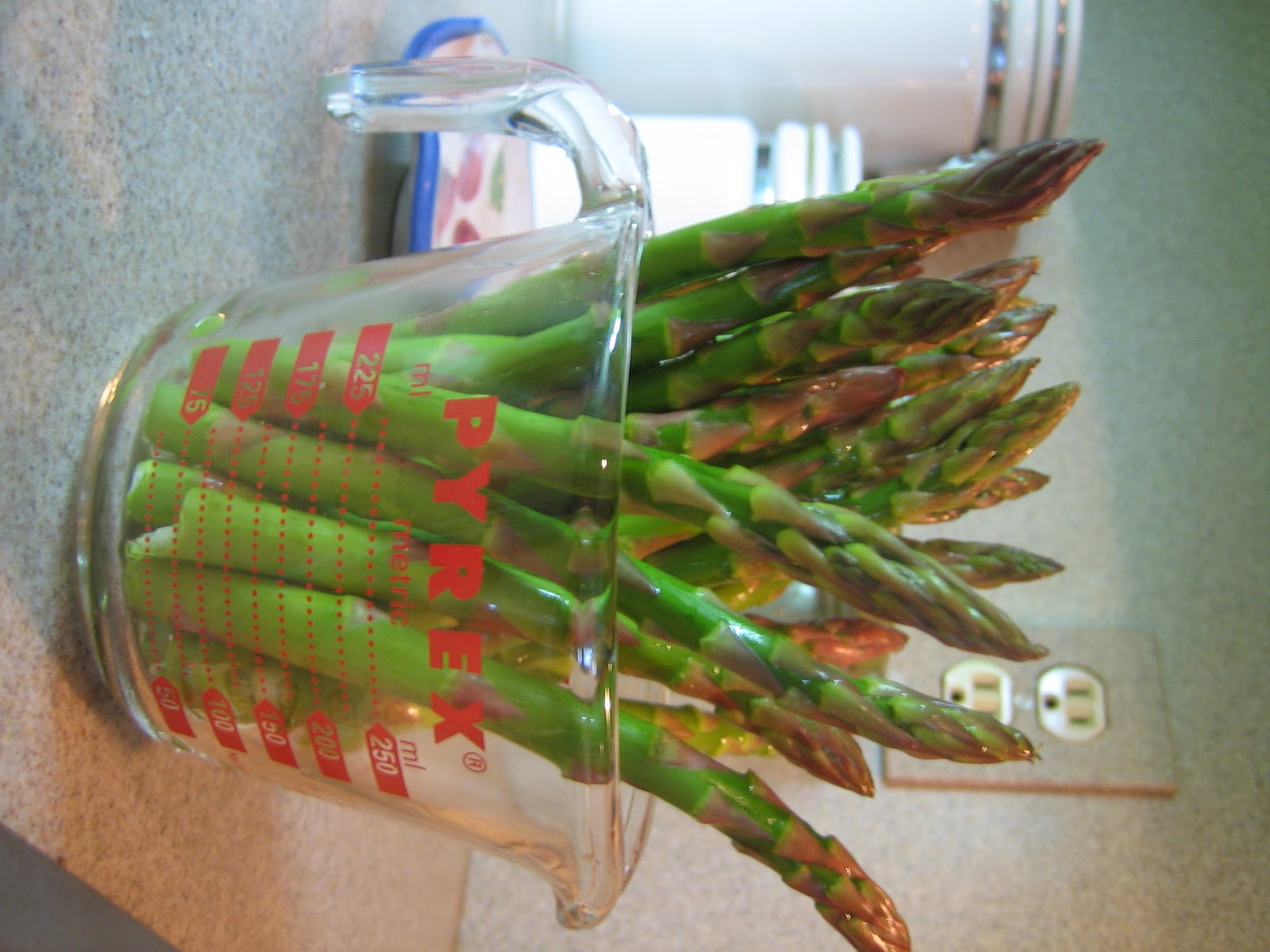
Is it weird to think asparagus is pretty?  Because I do.
I started making this recipe months ago, when asparagus wasn't readily available, and learned that all manner of green vegetables can be used to great effect, with a little tweaking of cooking time.  Green beans take beautifully to roasting, but need less time.  Brussels sprouts need a little longer, but the next time you get a sprouts-hater coming to dinner, try this recipe with its creamy sauce, crunchy vegetables and salty cheese.  Conversion could occur.

This recipe makes tons of crema.  You can easily triple the asparagus and you'll have enough sauce.  Don't cut the recipe, though, because the crema is brilliant on pasta and toasted bread and with raw veggies.  It also keeps for at least two weeks in a Tupperware container.


Roasted Asparagus with Walnut Crema
Adapted from A16 Food + Wine

For the crema:
Sea salt
1.5 cups walnuts
1/2 cup and 1 tbsp. extra-virgin olive oil
1 small red onion, roughly chopped

For the asparagus:
Extra-virgin olive oil
1 large bunch asparagus (can easily triple this without increasing the other ingredients)
1 cup toasted walnuts, chopped
Sea salt

Good parmesan or pecorino cheese for topping

Preheat the oven to 500 degrees.

For the crema, bring a large pot of salted water to a boil.  Add the walnuts and blanch them for 8-10 minutes.  At the 8-minute mark, fish one out and see if it is slightly tender.  If so, you're done.  Drain the walnuts in a colander, reserving at least a cup of the blanching water.

While the walnuts are boiling, warm 1 tbsp. of the olive oil in a medium sauté pan over medium heat.  Add the onion and a pinch of sea salt and sauté until the onion turns golden and fragrant.  Remove the pan from the heat.

Put the onion, walnuts and reserved blanching water into the bowl of a food processor (a mini prep processor is probably big enough, depending on the size of the bowl).  Whir until creamy, and then taste.  Add a touch of salt if needed.  Then add the remaining 1/2 cup of olive oil and whir again.  It should look something like this:

Think of it as Italian hummus.  I could have processed it longer, but I liked the texture.
To make the asparagus, snap the woody ends off and place the stalks on a baking sheet.  Drizzle the asparagus with olive oil until lightly coated, and sprinkle with sea salt.  Roast the stalks in the oven for 8-10 minutes, removing when the stalks get lightly charred and are fork-tender.  Keep an eye on them, because you don't want the stalks to get overcooked.


Finally, combine the toasted walnuts, a drizzle of olive oil and a pinch of sea salt in a small bowl and toss to coat the walnuts.


To assemble the platter--and you do want this on a platter because it looks spectacular--spread the crema first, then top with the asparagus.  Arrange the asparagus on the platter, and sprinkle the walnuts over--you will have extra if you are using only one bunch of asparagus, but they keep, too.  Shave a little parmesan or pecorino over the platter.


Serves 4 as a side dish.

Wine pairing:  Asparagus is notoriously not wine-friendly, but the roasting mellows it.  Dry riesling would work, as well as very light reds.  

Tuesday, August 30, 2011

Risotto alla Paesana, a/k/a Kitchen Sink Risotto

There comes a point where everyone has too many vegetables in their fridge and no idea how to use them.  Or maybe that's just me.

Until the much-discussed but not-progressing partial kitchen remodel happens, I have my current refrigerator, which I colloquially call "The Vegetable Murderer."

When we receive our CSA box every other Wednesday, it's always a scramble to use everything in the box before the Murderer gets to it.  I'm always looking for recipes to prevent mass vegetable homicide.

This risotto is adaptable to the vegetables that are gasping for survival in your refrigerator, or better yet, those you've found at your farmer's market or received in your CSA box.  In my case, the vegetables on which time was ticking were zucchini, mushrooms and celery.


Like many Italian specialties, this recipe involves very little meat.  Pancetta is the traditional ingredient, but since I bought some wonderful savory salumi at our local cheese store on Sunday, I used this instead.  If you can find Da Vino salumi, I highly recommend it.


The key to this risotto--and all risottos--is to take your time.  In homage to the Supremes, you can't hurry risotto.

Whatever you do, I beg of you, please do not skip the step of browning the rice--it adds an extra toastiness to the final product.


Risotto alla Paesana, a/k/a Kitchen Sink Risotto
Adapted from CIA Italian Cooking at Home

1/3 cup plus 1 tbsp. olive oil
2 oz. pancetta or salumi, sliced into small strips
3/4 cup chopped yellow onion
2 celery stalks, sliced
2 garlic cloves, chopped
2 1/4 cups pearl or Arborio rice
2 quarts chicken broth, warmed and sitting on a burner on low
2 bay leaves
1 1/2 cups peas, either fresh or defrosted frozen
1 cup zucchini
1 cup sliced mushrooms
4 tbsp. unsalted butter
1/2 cup grated fresh Parmesan

Heat all of the olive oil in a large pan (I used a Le Creuset casserole) over medium heat.  Add the salumi, onion and celery.  Sauté for approximately five minutes, then add the garlic and sauté for another minute.

Add the rice and stir until it is coated with the oil and toasty, which should occur within two minutes.  Add a pinch of salt and taste--the broth will add lots of salt later, so be sparing with the added salt.

Add the bay leaves and enough broth just to cover the rice.  Stir frequently, until broth is absorbed.  Add the mushrooms.  Keep adding broth by cupfuls as the previous addition evaporates, stirring constantly to ensure that the rice is not sticking to the pot.


While the rice is cooking, warm a large skillet and add two tablespoons of butter.  Add the zucchini and peas and sauté for approximately three minutes, until the zucchini is lightly browned.  When the vegetables are cooked, remove them from the heat and set aside. 

When the rice cannot absorb further rice, stop adding broth and add the zucchini-pea mixture.  Remove the risotto from the heat and stir in the last two tablespoons of butter and the cheese.  Stir until combined--the mixture will be a bit stiff, but this will make the risotto creamy.

Makes six to eight main-course servings.  David said this was "the best risotto" he'd ever had, but then he's biased.  We served the risotto with collard greens sautéed in olive oil and tossed with balsamic vinegar.


Wine pairing:  I recommend a full-bodied Italian white.  We had timorasso, which we bought in Pollenzo during our vacation this past spring.  Alternatively, pinot grigio or arneis would be delicious.


Tuesday, August 23, 2011

Kale and Cannellini Beans, Two Ways: A Love Story

It's August in Anchorage, which means one thing:  rain, rain, and well, more rain.

The rain took a very brief hiatus on Sunday, just long enough for me to do the half-marathon with my training partner, Paul.  We had a personal best time, the sun was shining and everyone felt a little bit better about living in Alaska in August.  Until yesterday, that is, when the clouds and rain moved back in.

On the plus side, there's nothing like an Alaskan August to get you thinking about fall foods, including serious dark leafy greens.  I've already posted photos of the kale and white bean bruschetta from last Friday, but the classic Italian combination of cannellini beans and Tuscan kale is also fantastic as a side dish.  I even made a sandwich with a piece of fresh baguette from my favorite artisanal baker, leftover salsa verde (recipe here) and some fantastic parmesan.  It sounds strange, but trust me, it was crunchy, chewy and somehow soul-satsifying.


Basically, this is a dish that can turn into a soup, a side dish and an appetizer.  If you used canned white beans, you can skip the first step.

Tuscan Kale and Cannellini Beans
Adapted from Bon Appetit, November 2010

1.5 cups dried cannellini beans, rinsed and picked over
1 cup chopped yellow onion
3 garlic cloves, peeled
1 dried bay leaf
1 tsp. salt
4 cups Tuscan kale, stems removed
3 tbsp. fresh lemon juice
4 tbsp. extra-virgin olive oil
Red pepper to taste

Put beans in a large pot and cover them with cold water, bringing the water to at least three inches over the beans.  Bring the pot to a boil and let it boil briefly, about a minute.  Remove the pot from the heat, put a lid on it and let the contents sit for an hour.  Then, drain the beans, return them to the pot and add an additional eight cups of water, along with the onion, garlic and bay leaf.  Bring to a boil, then reduce heat to low and simmer until the beans are tender but not mushy.  This should take approximately an hour to an hour and a half. 

While the beans are cooking, destem and roughly chop the kale.  When the beans are ready, add salt and kale and cook for an additional four minutes.

Drain the pot and transfer the beans and kale to a large serving dish, and the boiling liquid can be kept if desired to add to stock.  Add the oil, lemon juice and red pepper--I used tiny dried Italian peppers labeled peporoncini, and I would start with one and add another if I wanted more spice.  Gently combine the ingredients and add additional salt if necessary.

Serves up to 12 as a side dish, but I recommend setting aside some for the bruschetta:

White Bean Bruschetta with Kale
Adapted from Bon Appetit, November 2010

1/2 good-quality baguette, cut into 1/2 thick slices
1 garlic clove, halved
Extra-virgin olive oil
1.5 cups of the kale and cannellini mixture from the above recipe

Cut the baguette--I prefer diagonal slices, which also has the advantage of leaving the ends to snack on while cooking.  Rub the bread slices with the cut side of one of the garlic clove halves.  Brush the bread with the olive oil and toast under the broiler until just golden.

Top with the kale and cannellini mixture and serve.  Makes twelve appetizers.

Wednesday, August 17, 2011

Beet It

I have a love-hate relationship with beets.  When I was four and would only eat hamburgers on a vacation (ketchup and pickles only, please, don't even consider putting mustard or onions on them), the other thing I was guaranteed to eat were beets.  As in canned beats.  As in the overly-brilliantly-colored, salad-bar staple.  Several decades older, I shudder at the thought.

I became a much more adventurous eater when I moved to New Orleans at 17, but never contemplated eating a beet again until five years ago, when the ubiquitous roasted beet and goat cheese salad began appearing on restaurant menus, well, everywhere.  After a few less-than-inspired versions, I wrote beets off again.

And then they arrived in last week's CSA box, with their plumy greens and garnet color.  The color is so vibrant that I can't even come up with the right words to describe it.  I decided gave them another chance.  This salad tempers the sweetness of the roasted beets with crunchy, bright fennel and a simple olive tapenade vinaigrette.

Roasted Beet Salad with Fennel and Olive Tapenade
Adapted from A16 Food + Wine

1 bunch medium red beets (about 3-4 good-sized beets)
Kosher salt
Up to 1/2 cup good olive oil
1 fennel bulb, trimmed of the stalks and fronds
1/3 cup pitted black olives
1 tablespoon red wine vinegar
1 tbsp. fresh lemon juice
Shaved ricotta salata or parmesan cheese, for serving

Wash the beets with their greens, and remove the top and stem of the beets.  Keep the greens--they can be used in another recipe that I will post separately.

Preheat the oven to 400 degrees.  Place the beets in a small roasting pan, drizzle with olive oil and a generous sprinkling of salt.  Cover and roast until the beets are tender when poked with a knife, about an hour.  Then remove from the oven and left them cool enough to be picked up and peeled, either with fingers or a paring knife.  Slice the skinned beets into small wedges and set aside.

To prepare the fennel, cut the bulb in half lengthwise and remove the tough core.  Slice each half into 1/4 inch pieces and bring a small pot of salted water to boil.  Submerge the fennel in the water briefly (less than two minutes), drain and immediately rinse with very cold water to stop the cooking process.

Then, make the olive vinaigrette.  Put the olives in a small food processor and chop until they are in small pieces.  Add the vinegar and then add in the olive oil by tablespoons, until the mixture comes together--the whole process should take less than a minute.  Add extra vinegar or a little salt to taste.  This could also be made by hand or in a mortar and pestle--fine chopping is not required.

In a small bowl, mix the fennel with the lemon juice and a pinch of salt and drizzle in another tablespoon of olive oil.  Toss the mixture until the fennel is coated and taste.  Add extra lemon juice or another bit of salt to taste.

In another bowl, combine the olive vinaigrette and the beets.  Toss to combine.

This looks better on a platter than on individual plates--place the fennel mixture on the bottom, then top with  the roasted beets.  Shave the cheese over the top.  I used ricotta salata, which is mild-tasting, but parmesan or pecorino would work too.


Serves 4 as a first course or two with leftovers.  The salad holds up well in the refrigerator for a couple of days, although assume any cheese left on it will immediately be colored purple from the beets.