Food Buzz Badge

Showing posts with label dessert. Show all posts

Wednesday, February 20, 2013

Mise en Place

I love the term mise en place, which is basically French for having your ingredients together (I almost said having something else together, but never mind--it's been that kind of week) before you start.

I thought I did--really!

This month's Cake Slice pick was a red velvet cake, but with a frosting that mixed creamy marscapone cheese with the more standard cream cheese.  Here's where it gets hairy.  I thought I had red gel food coloring, which is essential for getting that deep, beet red color into the cake.

But it turned out to be pink gel color.  Oops.  The result was a lovely cake that was a deep brown-red due to the cocoa.  It was moist and tender, with gorgeous crumb.  The frosting initially looked like it wasn't coming together, but then I turned the hand mixer up on high and it whipped right up. 

I'm not convinced the cake recipe was particularly special, but the marscapone-cream cheese frosting was:  creamy, fluffy and not too sweet once I slightly reduced the amount of sugar.  It's a keeper.

As a total aside, red velvet cake was one of the specialties of my paternal grandmother, who was a professional baker.  Every time I eat it I think of her.

Marscapone-Cream Cheese Frosting
Adapted from Vintage Cakes by Julie Richardson

8 oz. cream cheese, softened
8 oz. marscapone cheese
1/3 cup sugar
1/2 cup heavy cream
1 1/2 tbsp. vanilla extract.

Beat together the cream and marscapone cheeses with a hand mixer on medium speed until they are light and fluffy.  Add the heavy cream, sugar and vanilla and turn the mixer up to high.  Beat until the icing is fluffy and the cream is fully whipped.

This recipe produces enough frosting to spread between the layers of a two-layer cake, and to thinly cover the sides and top.  Due to the cream in it, it will need to be kept refrigerated.

Monday, October 22, 2012

Sugar & Spice

Allow me to recount a conversation I had with David yesterday as we were compiling a grocery list for last night's dinner party:

Me:  Do we have molasses?

David:  Yes.  Two kinds.

Me:  Is there at least a cup?  That's how much I need for this cake.

David:  Definitely.

The problem was that I didn't ask what kind of molasses.  I assumed one was milder and the other was darker.  Little did I know that one of them was pomegranate molasses, typically used in Middle Eastern food but not exactly suitable for a ginger spice cake.  However, by the time I discovered this all the ingredients were on the counter and I had to get started.

This cake was probably meant to be ginger-spicy and sweet, but ended up slightly tangy due to the pomegranate molasses.  Although it was tasty, it wasn't quite what everyone was expecting.  It was amazingly tender, though.

The original recipe is for a snack cake to be dusted with powdered sugar, but I added a light layer of cream cheese frosting and sprinkled additional candied ginger over it to dress it up for the dinner.

Farewell to The Cake Book as the Cake Slice book for the year!  It's been interesting (and by interesting, I mean there were some interesting cake fails in my kitchen), but next month we start working from Vintage Cakes.

Ginger Spice Cake
Adapted from The Cake Book by Tish Boyle

2 1/2 cups all-purpose flour
1/2 tsp. ground ginger
2 tsp. baking soda
1/2 tsp. ground cinnamon
1/4 tsp. salt
1/3 cup crystallized ginger, chopped
3/4 cup pomegranate molasses
1/4 cup mild molasses
3/4 cup brown sugar, packed (I used dark)
2 large eggs
1/3 cup fresh ginger, finely chopped
1 cup unsalted butter, cubed
1 cup water

Preheat the oven to 350 degrees and prepare a 9-inch springform pan. 

Whisk together the flour, ground ginger, cinnamon and salt;  remove two teaspoons of this mixture and transfer them to a small bowl.  Mix the candied ginger with the two teaspoons of flour.

Mix together the molasses and brown sugar in a large bowl, then add the eggs and mix until blended.  Add the candied ginger and mix again.

Heat the butter and water together in a small saucepan, and whisk until the butter is melted.  Stir in the baking soda, and then remove from the heat.  Add half a cup of this to the molasses mixture to temper it--this will foam wildly, hence the need for the large bowl.  Then whisk in the remaining butter mixture.

Whisk in the flour mixture and candied ginger, then pour the batter into the springform pan.

Bake for approximately fifty minutes.  This time is approximate, so use a toothpick and check at the forty-minute mark.  Cool the cake on a baking rack before removing the side of the springform pan.

Dust with powdered sugar or add cream cheese for a "dressier" cake.  Serves 10-12 depending on the size of the slices.

Monday, August 20, 2012

Lost and Found

There is nothing like bringing a dish back from the brink to make you feel a sense of accomplishment.

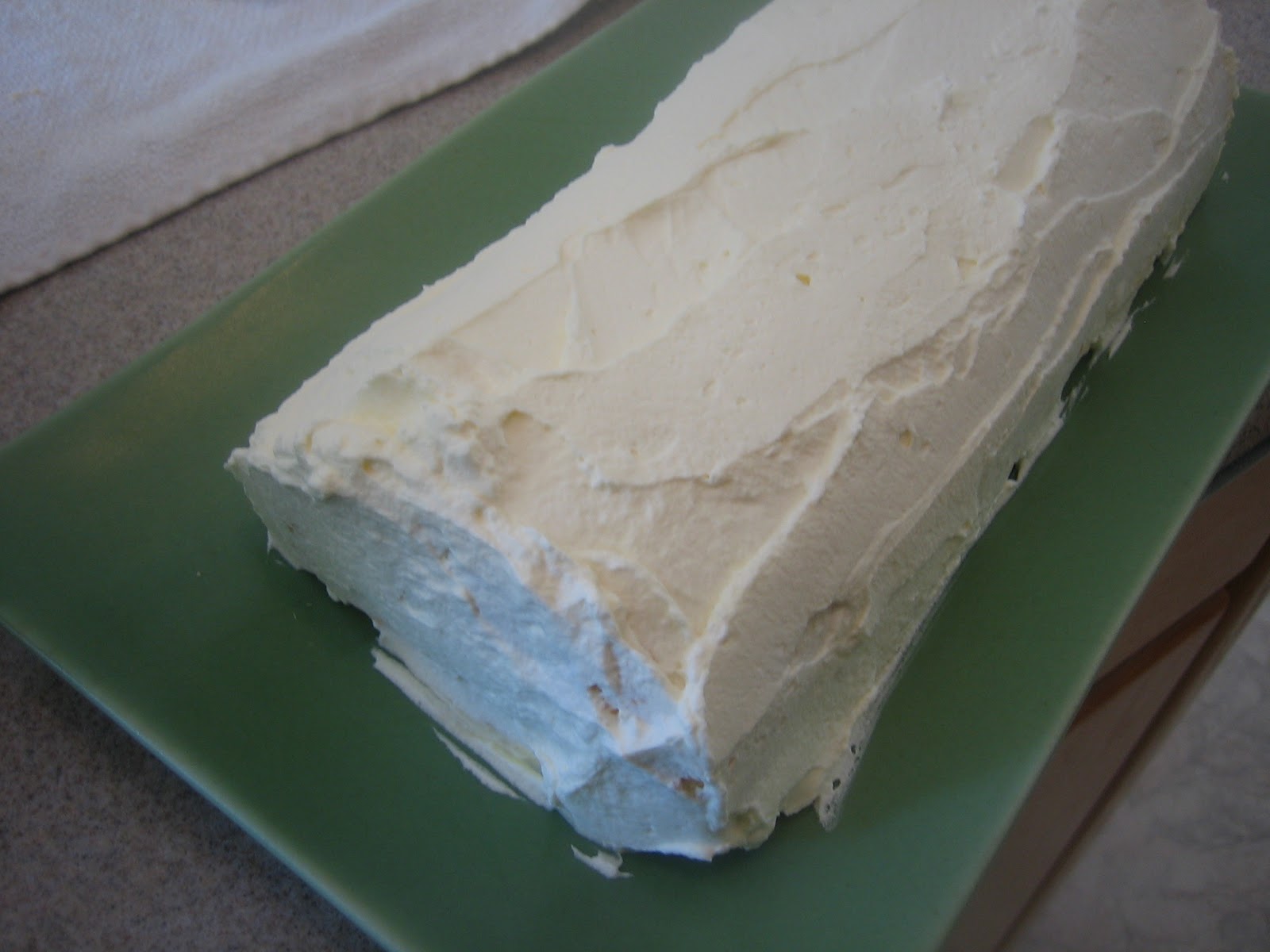
This month's Cake Slice pick, an "ultimate lemon roll," sounded fantastic.  However, like so many of the other desserts I have made from Tish Boyle's The Cake Book, in execution it turned out to be a bit sloppier.  As in crumbling sponge cake, oozing lemon curd kind of sloppy.  Eesh.

Since I was serving this as dessert for Erika's going-away dinner, I wanted it to look presentable.  Everything tasted good, it was just too messy to put on a platter and serve for dessert.

Enter the savior of many a baker with a less-than-gorgeous cake:  frosting.  Specifically, frosting made from the remainder of the pint of heavy cream I purchased for the recipe.


As an aside, why is heavy cream not sold in containers smaller than a pint anywhere in the Municipality of Anchorage?

I whipped up that cream with a tiny bit of sugar and some vanilla, and frosted the heck out of the cake.  It covered the bumps, cracks and general lack of beauty, and gave it a certain je-ne-sais-quoi to boot.

If I made this again, I would go with a straight lemon curd filling, minus the cream.  Regular curd is thicker and therefore less likely to ooze.

In other advice, buy a lot of lemons.  I used at least five in making all the components of the cake.

The (Kinda, Sorta) Ultimate Lemon Roll
Adapted from The Cake Book by Tish Boyle

For the filling:
7 egg yolks
1 1/4 cups granulated sugar
1 tbsp. lemon zest
2/3 cup fresh lemon juice
Pinch of sea salt
1/2 cup unsalted butter, sliced into tablespoons
1/2 cup heavy cream

For the cake:
1 1/4 cups cake flour, sifted
3/4 cup granulated sugar
1 1/2 tsp. baking powder
1/4 tsp. kosher salt
3 eggs, separated
1 tbsp. lemon zest
1/4 cup fresh lemon juice
1/4 cup vegetable oil
1 tbsp. water
1 1/2 tsp. vanilla
1 egg white
1/2 tsp. cream of tartar
Powdered sugar

For the frosting:
Remainder of pint of heavy cream
1 tsp. vanilla
1 tbsp. granulated sugar

First, the lemon curd filling:

In a medium saucepan, whisk together the egg yolks and sugar, then place the pan on medium heat and add the butter, lemon zest and juice and butter.  Whisk the mixture together for about ten minutes, or until it thickens.  Using a fine strainer, strain the curd into a medium bowl, preferably a metal one.  Place the metal bowl in an ice water bath and stir frequently for fifteen minutes.  The curd should be slightly chilled.

During this process, be careful not to splash water into the curd, or disaster will ensue.

Next, the cake:

Using a hand mixer, whip 1/2 cup of the heavy cream at high speed until the soft peak stage.  Fold the cream into the curd in stages, then cover and refrigerate this mixture.

Preheat the oven to 325 degrees and prepare a jelly roll pan for the cake.  Line the bottom of the pan with parchment and sprinkle it with powdered sugar.  In a medium bowl, sift together the flour, 1/2 cup of sugar, the baking powder and the salt.  Whisk these ingredients together.

Using the hand mixer again, beat the egg yolks, lemon zest and juice, oil, water and vanilla until just blended.  Add the flour mixture in four installments and mix again.

If you look carefully, you can see the
start of the dreaded oozing.

In another medium bowl and using clean beaters, beat the egg whites and cream of tartar until the soft peak stage.  Drizzle in the remaining 1/4 cup of sugar, then increase the mixer speed to high.  When the whites are very stiff, fold them into the cake batter and then spread the batter in the jelly roll pan as evenly as possible.

Bake the cake for about fifteen to eighteen minutes, until it is lightly colored and springs when touched.  Place a baking rack over the cake and invert the pan so the cake ends up on the rack.  Do this as gently as possible, because this cake wants to crack. 

Remove the parchment paper from the bottom of the cake, then roll the cake using the parchment paper--the paper will be rolled up with the cake.  Let rest on the baking rack until fully cooled.

When the cake is cool, unroll it and trim the edges on the short ends.  Spread the lemon mixture to within one inch of the cake edges, then re-roll the cake and transfer to a serving platter.  You will have leftover curd.

Finally, when the cake appears to be lost, the frosting:

When your cake doesn't look presentable, whip the remaining cream with the vanilla for the frosting, drizzling in the tablespoon of sugar.  Wipe up any lemon curd that has oozed out of the cake and onto the platter and then frost the heck out of the cake.  Cover and refrigerate immediately.


I served the cake slices with a pool of the curd mixture beneath them and garnishes of the remaining frosting on the side.

Monday, May 7, 2012

When Life Gives You Lemons

Have you ever woken up in the morning with a feeling of dread that something bad was going to happen that day?  That was Saturday for me...and as it turns out, I was right.  But that's too long and hard a story to tell right now.  It's Monday, after all, and we all need to think about more cheerful things.

The table looked gorgeous--I had David and a long-unused set of china to thank for that.
Last week was a whirlwind of work and appointments--we leave on vacation in less than a week, and with a cat diagnosed with bronchitis, houseguests (who we were actually terribly happy to see), work up to my ears and a to-do list as long as my arm, I didn't even touch my blog for another week.

Which means that I am behind in telling you about good events, such as the tea party I threw a week ago yesterday.  You may remember that my friend Arlitia started an event called "Tea and Strumpets," which was really an excuse for a fascinating group of women to get together, eat baked goods and drink lots of tea. 

When Arlitia held the first one, she made two varieties of scones, tea sandwiches and set out what must have been twenty teas to choose from--I lacked her tea variety, but I was determined to make what I think of as proper tea accoutrement--whipped cream, lemon curd, berry sauce plus crumpets and scones.

The crumpets discussion will have to wait, because those suckers were finicky.  Let me tell you about the absolute hit of the party.

Lemon curd.

I love lemon curd, but who knew it was so popular?  It's also ridiculously easy to make, a gorgeous color and you should never buy the stuff again.  It would make a perfect holiday gift in beribboned jars.

Lemon Curd
Adapted from Gourmet Magazine, April 2001

2 tbsp. lemon zest, finely grated
Juice of four lemons (about 1 cup)
Pinch of sea salt
1 cup granulated sugar
4 large eggs
1 3/4 sticks unsalted butter, cut into small cubes

In a small, heavy pot, combine the lemon zest and juice, sea salt, sugar and eggs and whisk together thoroughly.  Turn the stove on low and add all the butter in one batch.  Cook, whisking frequently, until all the butter melts and the curd thickens.  Do not let it boil, but when the curd is thick enough that you can see the whisking marks, remove the curd from the heat and strain it through a fine sieve or cheesecloth.

Transfer the strained curd to a small bowl and press a piece of plastic wrap against the surface.  Chill until the curd is thoroughly cooled, about 45 minutes.

Makes about 2 1/2 cups curd.